All writing © 2009-2015 by Colin Salter unless indicated otherwise. All rights reserved.
More information at www.colinsalter.co.uk

Saturday, 4 June 2011

PLUMER VERRALL (1782-1852) AND THE GOLDEN HAMMER

I was writing here a while back about George Vernon the actor, born George Verrall, and made some poor jokes about the profusion, and confusion, of George Verralls in that branch of my family tree. But the Georges were part of an orderly line of Verralls who were prominent citizens of the Sussex town of Lewes, in their capacity as auctioneers.

Verralls were auctioneers for five generations

It was George Verrall (1716-1801), brother of William Verrall the chef, who founded the auction house. It remained a family business until at least his great great grandsons’ generation. From George it passed to his son, also George (1750-1825), and son George passed it on to his son, Plumer Verrall. To quote from the recent bulletin (no. 10, 6 May 2011) of the Lewes History Society, “Lewes auctioneer Plumer Verrall sold anything he was asked to – estates, individual houses, business stock in trade, wine, investments, standing timber and crops, livestock, farm equipment and furniture. He sold whole households, or individual items such as beds, chairs and pianos. He and his son often bought and sold items in the sales on their own account.”

The bulletin mentions an occasion on 10th November 1838 when Plumer snapped up a valuable property within the precincts of Lewes Castle when the bidding stalled. Not only did he pick up a bargain, but he sold off the contents at auction a few weeks later for a tidy sum. I suppose it is one of the perks of being the auctioneer! Clearly no one thought any the worse of him for it, and on 21st March 1842 he was presented with a gold auctioneers’ hammer, “to commemorate the triumph of integrity.”

One of the reasons for the high regard in which he was held was an extraordinary event six years earlier. The winter of 1836-37 was exceptionally harsh. Snow began falling heavily in the south east of England on Christmas Eve 1836 and continued for several days. On 27th December a large overhanging cornice of snow on the steep chalk cliffs behind the town of Lewes, sculpted by the high winds of the blizzard, gave way and crashed down onto a row of houses below.

The Lewes Avalanche (unknown artist)
a painting now hanging in the Anne of Cleves House Museum 
in the town

Seven houses were destroyed and eight lives lost, although a further seven people were pulled from the avalanche and survived. The Lewes Avalanche of 1836 remains the worst such natural disaster in British history. A pub named the Snowdrop Inn, built soon afterwards on the site of the demolished houses, still stands and trades under that name. In the aftermath of the tragedy, Plumer Verrall was one of several prominent figures in the town to establish a fund in support of survivors and the families of the deceased. His charitable generosity must have earned hm widespread respect.

The Snowdrop Inn, Lewes,
beneath the chalk cliffs from which the snow fell

Plumer’s son William Richard Verrall (born in 1812, the only boy of nine children) took over the family business, by now known as Verrall & Son, when Plumer died in 1852. Richard acknowledged in advertisements “the very extensive patronage his Great-grandfather, Grandfather, Father and Himself had enjoyed for upwards of a century, and trusted by punctuality, perseverance, and prompt settlement of accounts to maintain the high position of his predecessors.” Sadly it was not to be. On 27th May 1855, Richard was found near the locks of the Ouse Navigation, drowned, with his throat cut.

The business passed to Richard’s cousin John Verrall (1805-1874) brother of George Verrall/Vernon the actor. John's son John Marcus Verrall (1839-1895) inherited the golden hammer and the family business. But when JMV died unmarried aged only 56, I think it was the end of the line for the Verrall auction house. But not for the hammer of for Verrall auctioneers. The hammer passed to JMV's brother George Henry Verrall (1848-1911). 

George was a remarkable man, of whom I will write in a future article. Both brothers were very much involved in the sport of kings, in several capacities including Clerk of the Course at Lewes and elsewhere. Maintaining a tradition begun by Plumer Verrall of striking a golden blow only when lots fetched a thousand guineas or more, George is reputed to have used the golden hammer for horses sold in the ring at Newmarket. I don’t know where the hammer is now!

Saturday, 28 May 2011

THOMAS GURNEY (1705-1770) AND THE OFFICIAL RECORD


The last edition of the current series of Word of Mouth (BBC Radio 4’s programme about aspects of the English language) was broadcast earlier this month. It was a brief history of the art of shorthand-writing, in which I have an ancestral interest, so I tuned in out of curiosity.

Thomas Gurney (1705-1770)
with the symbols of his invention

It was a good programme as far as it went – the Romans used shorthand, which I didn’t know; and the Elizabethans reintroduced it, which I did know (all those transcription errors in trying to capture Shakespeare’s scripts from live performances!). However from there it cut straight to some admittedly fascinating archive recordings of the original Mr Pitman, leaving a glaring gap - no reference at all to the Gurney System of Shorthand, the first modern system, invented in 1722 by my 5x gt grandfather Thomas Gurney.

It was the first system used in verbatim reporting of events, in which it was proved to be capable of extremely accurate record. Gurney Shorthand was the official system of both the Old Bailey (from 1750) and of both Houses of Parliament (from 1813) throughout the 19th and early 20th century, presided over by at least six generations of the Gurney family and widely used - not least by Charles Dickens who used it as a young reporter in the House of Commons, and whose firsthand experiences of learning shorthand were quoted in the Radio 4 programme!

Shorthand notes written by Charles Dickens
and preserved in the Dickens Museum, London

My first ever blog post here was about William Brodie Gurney, Thomas’s grandson, who took eye witness statements at the shooting of prime minister Spencer Perceval in 1812. WBG was also present at the trial of Queen Caroline in 1820 and at many other great political events and proceedings. The firm of WB Gurney & Sons still exists, and recorded proceedings at the inquiries into the sinking of the Titanic (1912) and the  Herald of Free Enterprise disaster (1987).

The first edition of Thomas Gurney’s Brachygraphy: Or An Easy And Compendious System Of Shorthand appeared in 1750. By 1924 when his great great grandson William Henry Gurney Salter was writing A History of the Gurney System of Shorthand, Brachygraphy was in its 18th Edition. WHGS, my great grandfather, also held the official post in the Houses of Parliament; he was succeeded in it by his nephew William Gurney Angus, the last direct descendent of Thomas Gurney to follow in the founder’s footsteps.

Frontispiece of Thomas Gurney’s Brachygraphy:
Or An Easy And Compendious System Of Shorthand
(15th Edition)

It’s probably just as well that Word of Mouth made no reference to Gurney Shorthand: there’s enough here for a whole other programme. And if anyone from the BBC is reading this, I’m happy to write the script!

Saturday, 21 May 2011

EYRE MASSEY (1719-1804) AND THE UNION PEERAGE

I am writing during a week in which Elizabeth II has made a historic and controversial state visit to the Republic of Ireland, the first by a British monarch to that country since 1911, when it was still under British rule. My thoughts turn to my Irish ancestors, who were themselves descendents of earlier waves of English settlers planted in Ireland by earlier conquests. Known as the Protestant Ascendancy, such descendents were the ruling classes of Ireland, the landed gentry against whom the ordinary people of Ireland fought for their independence.

The Massys were a large and powerful Ascendancy family. They first came to Ireland in 1641 and through consolidation of their position they acquired estates running to many thousands of acres. Such wealth seems to attract further wealth, and in 1757 Hugh, 1st Baron Massy and my 5x great grandfather, inherited the estate of Elm Park at Clarina, Co. Limerick. Having already the huge Duntrileague estate in the county, Hugh passed Elm Park along to his younger brother George, an Anglican clergyman who lived life to the full at Elm Park and died of apoplexy in 1782.

Eyre Massey (1719-1804)
in a portrait possibly by Robert Hunter
sold in 2009 by Christie’s for £22,500

Elm Park then passed to Hugh and George’s youngest brother, my 6x great uncle Eyre Massey. Eyre was 63 at the time. As the youngest of six Massy brothers he had lived his life with no prospect of inheritance, and had therefore had to work for a living. This he did by a distinguished military career, serving for over 60 years with his regiment the 27th Foot, the Enniskillings.  He fought campaigns in the West Indies, Scotland and Canada (to which I’m sure I’ll return in later posts), retiring from active service with the rank of Lieutenant-Colonel in 1782 to take on the responsibilities of Elm Park.

Eyre came out of comfortable semi-retirement in 1794 to take military command of the city of Cork, then preparing for the threat of invasion by Napoleonic France. His suppression of a mutiny by 2000 young recruits there in 1795 earned him a promotion to the rank of General. Two years later he was appointed Governor of the city of Limerick, and further promoted to Marshal of the Army of Ireland.

You’d think, now that he had estate and rank, that the 78-year old would be content with his lot. He had a very happy homelife by all accounts, having wed Catherine Clements, 25 years his junior, whom he described in 1798 as “a very virtuous good wife, and a most excellent mother … whom I adore” – remarkably affectionate language for the times, and after 30 years of marriage too. But in 1796 their eldest son George had died aged only 25; and more in an attempt to console Catherine than for his own aggrandisement, he now sought a further honour – a peerage.

His desire for elevation coincided with political events in Ireland – the move towards a formal union of Ireland and Britain by the Acts of Union in 1800, which abolished the Irish houses of parliament in favour of direct rule from London. 26 new peerages, the so-called Union peerages, were created in Ireland to ease the passage of the bill, and one of the very last peers to be so elevated – on 27th December 1800 – was Eyre Massey, 1st Lord Clarina of Elm Park.

Eyre, by now 81, lived as Lord Clarina for only four years before his death in 1804. The United Kingdom of Great Britain and Ireland legitimised by the act survived until it was violently dissolved by the Irish War of Independence in 1921 – which is why it has taken until now for a British monarch to walk on Irish soil again.

The Union flag, (above) of Great Britain (1606-1800)
(and below) of the United Kingdom of Great Britain and Ireland (1801-1921)

Information in this article comes from various sources, not least the detailed biography of Eyre by Matthew Potter in the Summer 1998 edition of the Old Limerick Journal.

Saturday, 14 May 2011

HAMPDEN GURNEY JAMESON (1852-1939) AND THE ART OF BRYOLOGY

Apologies if you’ve come here in search of Jameson Moss the young actor and musician! What are the chances of you finding instead my cousin Hampden Gurney Jameson, the celebrated botanical artist who specialised in illustrations of British mosses?

Hampden Gurney Jameson (1852-1939) c1892

I wrote recently about my indigo-trading Jameson ancestors, of whom William Gurney Jameson was the last to deal in the exotic dyestuff. Hampden was William’s younger brother. Coming like so many of my ancestors from a proud philanthropic and nonconformist background he enrolled in around 1870 as a medical student at the University of London (the institution established in 1826 by nonconformists at a time when they were barred from other universities in England).

But perhaps in emulation of his mother’s cousin, his near namesake John Hampden Gurney who became a priest, Hampden Gurney Jameson dropped out of medical school and himself trained for holy orders at Oxford. After his ordination he served parishes in London, Lincoln and Eastbourne. But it was probably at Oxford that he fell in with a group of rarified botanists, the bryologists – students of mosses.

Capillary thread-moss (Bryum capillare) on a stone wall
photographed in Dumbartonshire by Lairich Rig

I imagine that bryologists are to botany what indigo merchants are to general trade – pretty specialised. But if you’ve stopped for even a moment on a country walk to look closely at a patch of moss on a tree or wall, you’ll know just how varied and beautiful these plants are – so much more than merely the wadding to line your summer hanging baskets with. Hampden was clearly swept along by his Oxford companions’ enthusiasms and began to study, write and draw.

He wasn’t the first or the last man of the cloth to make an important mark on the study of nature – think of Rev Gilbert White’s pioneering 1789 Natural History and Antiquities of Selborne. Hampden’s contributions included a Key to Genera and Species of British Mosses (1891) and his Illustrated Guide to British Mosses (1893).

Hugh Neville Dixon (1861-1944)

Hugh Neville Dixon’s Student’s Handbook of British Mosses first appeared in print in 1896, with 40 black and white plates of detailed illustrations by HGJ, many of them from Hampden’s own Guide. The third edition of Dixon’s book, in 1924, was reprinted twice, in 1954 and 1970 but has by now largely been displaced by E.V. Watson’s British Mosses and Liverworts (1955). However a facsimile edition of Dixon and Jameson’s long-running collaboration is now available once again, 115 years after it first appeared. Hampden’s drawings are kept in the archives of the Natural History Museum.

Dixon’s Student’s Handbook of British Mosses
with illustrations by Hampden Gurney Jameson

Much information for this article comes from Mark Lawley’s excellent online biographical sketch of Hampden.

Saturday, 7 May 2011

WILLIAM KINGSBURY JAMESON (1806-1864) AND THE INDIGO TRADE

An odd series of coincidences led me here. First of all I was writing an article on the history of dyes for a book about inventions. Quite separately about the same time, a friend lent me a copy of Simon Garfield’s popular history of the colour mauve. And then a day or two later someone got in touch with me via this blog: it turned out that our great great grandmothers were sisters, Emma and Mary Anne Gurney. Emma married William Augustus Salter, a young Baptist minister – he was ordained in his first church less than a fortnight before their wedding.  Her older sister Mary Anne married William Kingsbury Jameson, son and heir of William Jameson senior, an indigo merchant in the City of London.

Now that’s a profession you don’t hear much of these days! But when WKJ died in 1864, he left an estate of nearly £70,000, an indication of the economic importance of the global indigo trade at the time. Indigo the colour comes from indigo the plant, Indigofera tinctoria, which for thousands of years has been soaked in water and beaten to a pulp with bamboo sticks to produce the richest of all blues for painting and dyeing. For ease of storage, transport and trade the liquid is heated until it dries to a block of deep blue paste.

Indigo paste

The plant comes originally from the Indian sub-continent (which gave indigo its name), and contains in stronger measure the same chemical component as woad, the plant which was the traditional western European source of the colour blue. Indigo came to Europe when a Portuguese trading ship returned from the East with a cargo. From Portugal a consignment found its way in the 1570s to the docks of London.

Some European states put up protectionist resistance to indigo, which they saw as a threat to their native woad industry. But in time Britain saw the advantages of a valuable crop grown in the colonies of its expanding empire. In 1770 it was importing nearly a million pounds worth not only from Bengal but also from its plantations in South Carolina. France and Portugal also introduced the plant to their colonies in the Americas from Brazil to Mississippi.

Navy blue frock coat of a British admiral, c1805
when Britannia ruled the waves

It is the sheer depth of colour which made indigo such a precious commodity. And it became so valuable that merchants dealt in it as a currency of credit. As a dye, its popularity increased as the British textile industry expanded towards the end of the eighteenth century. The dark satanic cotton mills of northern England boosted demand for the deep exotic blue, in everything from Union Jacks to Navy Blue uniforms. A whole new class emerged in Britain, the blue-collar workers. In the age of Empire, Great Britain wore blue.

Britain, and merchants like the Jamesons, dominated the world indigo market in the first half of the nineteenth century. William Jameson senior was originally in partnership with a German entrepreneur called Charles Aders. But in 1832, the year William junior and Mary Anne got married, the firm of Jameson & Aders was restructured as William Jameson & Son. I imagine it was a wedding gift; but it may also have been that Aders was glad to be bought out. He was a passionate collector of early Flemish art who might have welcomed an injection of cash to pay for his acquisitions. As it was, Aders was declared bankrupt with a year or two of parting company with Jameson.

William Henry Perkin
invented mauveine, the first synthetic dye

Dealing in indigo was a license to print money, to judge from the value of WKJ's estate. What could possibly go wrong? Why aren’t the Jamesons indigo millionaires to this day? In 1856, an English chemist called William Henry Perkin accidentally invented the world’s first synthetic dye – he had been trying to synthesise quinine, a treatment for malaria. The new colour was mauve, the first of a wave of unimagined shades which excited the fickle world of fashion. Why be boring blue any more? Prices of traditional natural dyestuffs almost halved over the next five years, as colourful chemical alternatives were found. Although it was more than thirty years before a true synthetic version of indigo was found, cheaper approximations replaced it in many uses.

Karl Heumann
produced a viable synthetic indigo dye

Never again would indigo be the blue gold it had been for William Kingsbury Jameson and his father. WKJ’s son William Gurney Jameson did, it’s true, follow his father into the business. But trade tapered off, and in 1890 the German chemist Karl Heumann finally produced a viable synthetic indigo. By then WGJ had shut up shop. In 1881 he described himself merely as a general merchant; 1891 found him “living on his own means” at a boarding house in Bristol, and he died unmarried, the end of the line, the following year. Within twenty years  of Heumann's breakthrough the indigo industry was all but extinct.

Thanks to Ian Mackintosh, archivist of the Worshipful Company of Dyers, for help with background information about the indigo trade; to descendents of WKJ, who have shared their family knowledge with me; to Simon Garfield’s history of synthetic dyes, “Mauve;” and to Kate Long, whose definitive online thesis on indigo is a damn good read!

Saturday, 30 April 2011

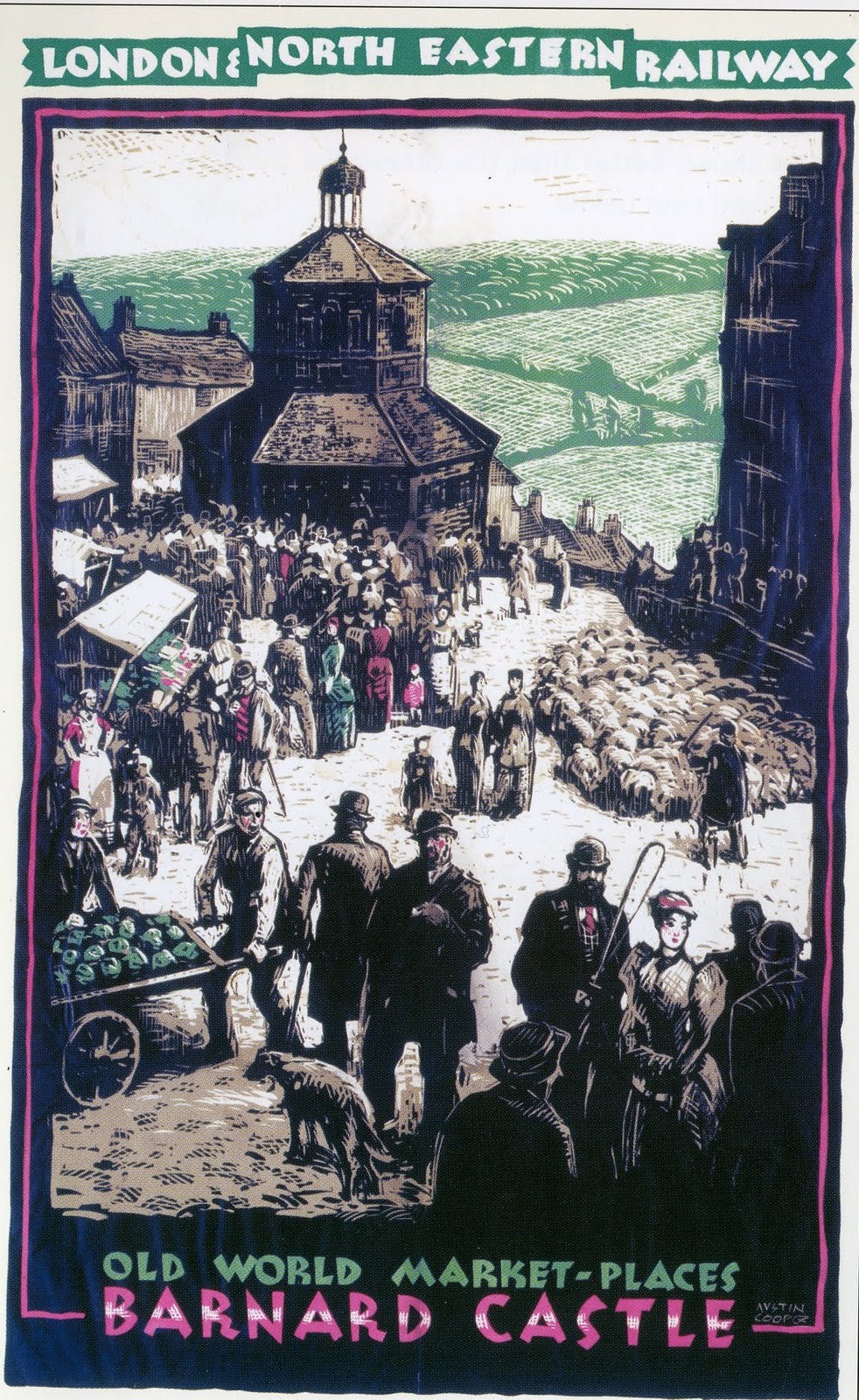
AUSTIN COOPER (1890-1964) AND THE OLD MARKET-PLACES OF ENGLAND

I wrote about my cousin Austin Cooper once before. He was Canadian, but served with the Black Watch Regiment during the First World War. With them he went through four years of trench warfare in some of the grimmest confrontations of the conflict including Passchendaele and Ypres. At the latter he survived a gas attack which killed many of the 60,000 Canadians lost in the war.

Austin Cooper was discharged in 1919
with the rank of Regimental Sergeant Major

In peacetime Austin was an artist. Between the wars he settled in England and made his mark as a poster designer, mainly for transport operations such as London Underground and the London Midland and Scottish Railway Company. For my money his best work was for the London and North Eastern Railway, LNER.

In later years he moved towards modernism and cubism, and eventually gave up poster design altogether in favour of completely abstract paintings. But in the 1920s and 1930s he produced several series of themed travel posters for the company including one for literary destinations called The Booklovers’ Britain, and this one, Old World Market-Places.


Old World Market-Places, 1927
Norwich, Boston, Barnard Castle and Knaresborough

It’s a beautiful set of stylized woodcuts, a nod to a medium recently repopularised by Noel Rooke and others. Cooper was a master of the type face too, and I think his design here particularly suits the graphic style of the images.

I don’t know whether there were any more destinations in the series. The Upper Teesdale line which served Barnard Castle is long gone. But Boston, Norwich and Knaresborough all still have railway stations. I'm a sucker for a market town, and all four (and particularly my soft spot Barney, as we used to call it) are still well worth the trip that Austin Cooper’s artwork was urging over 80 years ago.

Saturday, 23 April 2011

SIR RALPH SADLEIR (1507-1587) AND THE V.I.P. (PART TWO)


In 1584, my poor old 12x great uncle Ralph Sadleir was hauled out of statesmanlike semi-retirement by Queen Elizabeth I to fill the post of gaoler to Mary Queen of Scots at Sheffield Castle – a Very Important Prisoner indeed. Unfortunately for him his military and administrative prowess, his familiarity with Mary’s ways and above all his unswerving loyalty to his own Queen made him the obvious man for the job. At the age of 77, only his years of active service can have given him the strength to prepare himself and 43 of his own men for the weeklong ride north from his home at Standon in Essex, just outside London, to the small provincial town of Sheffield.

Sir Ralph Sadleir (1507-1587)
statesman, gaoler and hawking enthusiast

The journey exhausted him, but barely a week later he was on the move again, to Wingfield Manor fifteen miles away. It was not a suitable prison: Ralph declared that he would rather defend Sheffield Castle with 60 men than Wingfield Manor with 300. But Sheffield was swarming with conspirators, and Mary’s chains of communication with them needed to be broken. The transfer of his own retinue and the 47 staff and servants of Mary’s household took a full day: Ralph was bone-weary, and Mary, 35 years his junior, suffered badly from gout.

Wingfield Manor, Derbyshire
exposed to the elements

Wingfield was cold and damp, east-facing on heights above the River Amber in Derbyshire and exposed to harsh winds at the onset of winter. Despite Elizabeth’s assurances that Ralph’s was, in view of his age, a temporary appointment, he and Mary remained at Wingfield for four months. They were virtually prisoners of each other while Elizabeth tried to find a more permanent gaoler. Both Mary’s and Ralph’s health declined during their time at Wingfield.

In desperation Sir Ralph arranged yet another transfer in January 1585, to Tutbury Castle, a two-day winter journey away in Staffordshire. Tutbury was considerably more secure than Wingfield; and Sadleir was able to address its many short-comings of comfort because as part of the Duchy of Lancaster, the castle was under his own control. As winter turned to spring he allowed Mary, who shared his passion for hawking, to join him on days of sport beyond the castle walls.

Tutbury Castle, Staffordshire
a good base for days out

In spite of what might be called their professional relationship – she a captive Scottish queen, he an English queen’s gaoler – they were fellow travelers. Ralph had held the baby Mary in his arms 43 years earlier; and both must have sensed on some level that they were coming to the end of their respective roads. Mary was running out of options, Ralph simply running out of years.

When in April 1585 Elizabeth finally found a successor to Sir Ralph, it was Sir Amyas Paulet, a strict Protestant who allowed Mary none of the comfort, freedom and friendship she had enjoyed with my uncle. Within a year she was embroiled in the Babbington plot which led to charges of her conspiracy against Elizabeth. The commission which eventually signed her death warrant included a loyal but heavy-hearted Sir Ralph, unable and unwilling to protect his friend when she threatened his queen. Mary was beheaded on 8th February 1587. Sir Ralph died of natural causes on 31st March, less than two months later.

 
The tombs: Mary Queen of Scots in Westminster Abbey
and Sir Ralph Sadleir in Standon

“Our Man in Scotland,” Humphrey Drummond’s biography of Sir Ralph Sadleir, from which I learned a lot about Uncle Ralph’s time with Mary, is now out of print but very much worth tracking down secondhand.

Saturday, 16 April 2011

SIR RALPH SADLEIR (1507-1587) AND THE V.I.P. (PART ONE)

V.I.P. in this case stands for Very Important Prisoner. My 12x great uncle Ralph served under four monarchs, in some of the highest offices in the land – at the end of his career he was Queen Elizabeth’s Treasurer and Privy Counsellor. After his retirement, one of his very last duties for the Virgin Queen was as the reluctant gaoler of Mary Queen of Scots.

Sir Ralph Sadleir (1507-1587)
soldier and statesman

Sir Ralph had known Mary almost all her life, having been dispatched by Henry VIII to Scotland to arrange her marriage to Henry’s son Edward, Prince of Wales in March 1543 when Mary was less than four months old. Shown the baby at Linlithgow Palace that month, Sadleir had declared, “It is as goodly a child as I have ever seen of her age.” But when war broke out between England and Scotland later that year, Ralph served his English monarch loyally in what became known as the “rough wooing” of the Scots. For his part in the crushing defeat of the Scottish army at the Battle of Pinkie Cleugh in 1547 Sir Ralph received his knighthood.

Although Mary was crowned in 1543, (her father James V having died when she was just six days old,) Scotland was ruled by regents throughout her minority. When the last of them, Mary’s mother Mary of Guise, died in 1560, Mary took charge and refused to ratify the Treaty of Edinburgh negotiated that year by Sir Ralph and others. The treaty was intended to force Scotland to end its alliance with Catholic France and to recognise Elizabeth I as queen of Protestant England. But Catholics regarded Elizabeth as illegitimate; and as Elizabeth’s Catholic cousin, Mary (by now Queen consort of Francis II of France) was next in line.

Francis II, King of France, King consort of Scots,
and Mary, Queen of Scots, Queen consort of France
c1558, after Francis Clouet

Mary’s desire to unite the thrones of Scotland and England under her own Catholic regime dominated the rest of her life. She was the focus of innumerable plots to that end, by Catholic factions and nations as interested in their own agendas as in hers. For his part Sir Ralph was a religiously tolerant man, but implacably opposed to any move which might result in the surrender of English sovereignty, especially to the French.

When Mary fled to England in 1568 following her forced abdication of the Scottish crown, she became a big political problem. Civil War was a distinct possibility, and in 1569 Sir Ralph was dispatched to squash a Catholic rebellion by the Northern Earls of Westmorland and Northumberland. Mary meanwhile was being moved from castle to castle to keep her out of reach of conspirators and rescuers. She was a compulsive plotter, always planning new schemes and alliances to restore her to one throne or other. The job of gaoler to Mary Queen of Scots was a stressful one, only made possible by a network of vigilant spies and counter-spies.

Sheffield Castle (now demolished)
as it looked in 1819

In 1584, poor old uncle Ralph was hauled out of statesmanlike semi-retirement by Elizabeth I to fill the post temporarily at Sheffield Castle in Yorkshire. Unfortunately his military and administrative prowess, his familiarity with Mary’s ways and above all his unswerving loyalty to his own Queen made him the obvious man for the job. At the age of 77, only his years of active service can have given his the strength to prepare himself and fifty of his own men for the week-long ride north from his home at Standon in Essex, just outside London, to the small provincial town of Sheffield.

How would the man, whom Mary Queen of Scots had described 12 years earlier as “grave and ancient,” fare when pulled back into her world of intrigue? Come back next week and find out!

Saturday, 9 April 2011

CHARLES CASTLE (1813-1886) AND THE TENANT FARMER’S PLEA

I inherited the contents of Captain Charles Castle’s writing desk. Charles was my 3x great uncle and I have hundreds of letters sent to him, with drafts of many of his replies. Such a wealth of personal material paints a pretty rounded portrait of a complicated man, with a finger in many political and economic pies.

He was a Bristol man, from a wealthy old family, and it is not surprising to learn, on the evidence of one letter, that he owned property across the River Severn in Wales. In fact he owned, according to a registry of 1873, around 750 acres in Cardiganshire. This is a portrait of one of his correspondents, from the desperate appeal of widower David Edwards, a tenant farmer whom Captain Castle had given notice to quit.

 
David Edwards’ letter of 12th April 1859

Merthyr Tydfil
12th April 1859
Capt’n Castle
Dear Landlord,

do you determined not allow me remain in the farm after this year, you well know that I made a great improvement since I taken this, to say in short if you please give 14 years time I will give you £50 rent yearly, as I told you before we the children and myself are very angry to depart and another thing I do not believe you will get so much rent, I can pay more rent than some of whom made an enquiry to you for the farm, and I shall engage to put the bounds between us and within in good repair that nothing committed a trespass from my land to Wstrws and that you will have no accation [sic] to trouble yourself hereafter about the tenants of Wstrws and Clawddmelyn so long as the time above lasted & much humbly beg on you of send me your reply forthwith, if you please not consented to my desire I must look for another place ellswere which I do show you I and the children are very across to do so. I had a business here to day and I shall go from here this afternoon for Carmarthen to night.

I am dear Landlord
yours very truly
and [illegible word]ly
David Edwards

Capt’n Castle

PS if you please send the answer by return it will reach my residence so soon as myself. DE

This simple heartfelt letter is full of clues to its context, if not to the actual identity of its sender: David Edwards is one of the commonest names in Wales. Mr Edwards, I am guessing, was a Welshman and not a native English speaker. I am guessing too that there had been some trouble with livestock escaping from his farm and bothering the neighbouring tenants of Wstrws and Clawddmelyn. Perhaps complaints from them had led to his eviction. Wstrws and Clawddmelyn are farms at either end of the village of Capel Cynon, where Captain Castle held around 300 acres of land. I don’t know the name of Mr Edwards’ tenancy, but it would make sense if it were Capel Farm, which lies halfway between the two. A trip from Merthyr Tydfil back to Capel Cynon was a journey by horse and cart of 75 miles, which would certainly have justified an overnight stop in Carmarthen en route.

Worst of all, I don’t know what the outcome of this plea was. Unfortunately, knowing from his letters what a hard head for business Charles Castle had, I don’t think it will have ended well for David Edwards. If in this small world a local historian from Capel Cynon is reading this – please get in touch!

Saturday, 2 April 2011

STEPHEN SALTER (1825-1896) AND THE ALLOCATION OF ARCHITECTURE

It turns out there are not one but three nineteenth century architects (at least) named Stephen Salter. What started out last week as a simple post about the achievements of one of them, turned into a confusing meander through the many many MANY Stephen Salters past and present, related to me or each other or neither.

Anyway, I have a list of architects and a list of buildings designed by one or other of them. The architects are:

Stephen Salter, b. 1801
Stephen Salter, b. 1825, d. 1896, son of the above
Stephen Salter, b. 1861, not related to the above but son of another Stephen Salter

The buildings are by and large an impressive array of public institutions. Now that I’ve had time to sort them out, I see they fall into three quite distinct groups in terms of date or location. They are:

(above) Auditorium, Adelphi Theatre (demolished 1901);
(below) Basingstoke Town Hall and Corn Market

1856  St Paul’s Church, East Moseley, Surrey
1858  Adelphi Theatre, The Strand, London
1864  Basingstoke Corn Market

(above) Christ Church, Hendon;
(below) foundation stone of the Savoy Place Laboratories,
laid by Queen Victoria, Empress of India

1881  Christ Church, Hendon, north London
1884  Admiralty, Whitehall, central London (unsuccessful submission)
1886  Physicians/Surgeons Laboratories, central London
1889  8-8a Bourdon St, London (St George’s Women’s  Shelter)

(above) 1-3 High Street, Oxford;
(below) Sandlands, Boarhill, Oxfordshire

1896  Pangbourne villas, Berks
1901  1-3 High St, Oxford
1902  94 High St, Oxford
1904  Cowley Rd Methodist Church, Oxford
1905  Sandlands, Boarshill
1908  2-4 Charlbury Rd, Oxford

That last group are by date and record all by the 1861 Stephen Salter. There is a gap in time between the buildings of 1864 and 1881 (which of course is not to say that nothing was built by any of them during that period – absence of evidence is not evidence of absence) but in fact they could all have been the work of the 1825 Stephen. And although the 1801 Stephen describes himself in 1871 as a “retired architect,” in the 1851 census he declares himself an arguably less exalted “architectural modeller.” In 1851 his son Stephen is a fully fledged “architect.” So I’m going to attribute everything up to the Bourdon St Women’s Shelter to my 1825-born cousin.

After all that, the last word goes to the youngest architect and the only one I’m not related to. The seven villas which he designed along the river Thames at Pangbourne were not well received at the time. Even 33 years after they were built, a critic wrote:
“The row of villas near Pangbourne are an example of the pretentious and expensive sort of building which has not been mitigated by gardening. These houses have been locally christened the Seven Deadly Sins, which is sufficiently indicative of the opinion of the public upon such architectural disfigurement.”


Two of The Seven Deadly Sins, Pangbourne

They clearly reflect the eclectic Arts and Crafts style of Stephen Salter the younger, and as noted by a more recent writer, from Oxford County Council,
“These particular deadly sins seem to me to have become less fatal with age! Perhaps time and gardening have now mitigated what obviously looked brash when first built. I suspect that the particular deadly sin with which they can now be associated is Jealousy. How many people who love the river would not want to live there?”

One was on the market recently for £875,000.
Related Posts Plugin for WordPress, Blogger...