All writing © 2009-2015 by Colin Salter unless indicated otherwise. All rights reserved.
More information at www.colinsalter.co.uk

Saturday, 31 July 2010

JOHN THOMAS ADOLPHUS COOPER (1836-1897) AND HIS MANY TURKISH GONGS


It remains a family mystery why Adolphe Cooper, son of a prosperous Irish gentleman farmer should take a job laying submarine telegraph cables in the Eastern Mediterranean. Mind you, his father didn’t do much actual farming either, having spent much of his youth yachting around Europe. Adolphe was born in Brussels, the youngest of three brothers, all of whom opted for more modern sources of income. Austin, the eldest, was a railway manager in County Roscommon (the landlocked one north of Co. Galway); Sam became a chemical manufacturer in Peckham, South London. And for Adolphe, telegraph engineering was just the start. 

John Thomas Adolphus Cooper (1836-1897)

Finding himself the regional manager for the Levant Telegraph Company in Smyrna at the age of 23, Adolphe made the most of being an Englishman abroad. Five years later he married his Italian wife in Monastir, Tunisia, and his children were born in Salonika (present-day Thessaloniki in Greece) and Scutari (Shkoder in Albania). All these places were at that time still part of the Ottoman Empire.

Britain was held in high regard by Ottomans, having fought with the Empire against Russia in the Crimean War of 1853. Adolphe’s career advanced easily in the service of a regime eager to modernise its infrastructure; he was Superintendent of the Ottoman Government Telegraph Station in Salonika, and in Skutari he acted as the local Imperial Commissioner of the Ottoman Railway.

He survived massive political upheaval in the Empire in 1876, which saw one military coup, two regime changes and an attempt at constitutional reform. In fact the emerging new leader, Sultan Abdul Hamid II, greatly favoured Adolphe Cooper, who became his Chief Telegraph Engineer and Surveyor. The Sultan promoted him to “Imperial Commander of Roumelian Railways” (roughly speaking, Roumelia stretched from Albania to Bulgaria) and also made him responsible at some point for “the irrigation of the whole of Asia Minor south of Konya” (Konya is a city in southern central present-day Turkey).

I must say this seems quite a stretch of territory and professional responsibility for one man, however British he may have been. But Adolphe’s contribution to the modernisation of the Ottoman Empire cannot be disputed, based on the number of awards showered on him by the Sultan and others. These included:

in 1876, the Order of the Medjidie (4th Class) from the Sultan

in 1879, a Diploma of Honour from the Red Cross (for services to sick and injured Ottoman soldiers), not illustrated here!

in 1884, a Knighthood of the Order of Pius IX from Pope Leo XIII

in 1897, the Order of the Osmanieh from the Sultan

and in 1897, the People’s Order for Civil Service (Commander’s Cross 3rd Class) from King Ferdinand of Bulgaria (for being Inspector of the Eastern Railways in Odrin – Edirne in present day Turkey), 2nd Class version shown here

Adolphe's grandfather and my 4x great grandfather were brothers, so I'd be the first to admit this is a fairly tenuous ancestral connection. But who'd pass up the chance to enjoy all those gongs?

The picture of JTA Cooper and some of the information in this article comes from Butterhill and Beyond, a history of the Coopers by R Austin-Cooper.

Saturday, 24 July 2010

RICHARD FRANK SALTER (1921-1944) AND THE HELL SHIP


I wrote a while back about David Castle who died at Tobruk during the Second World War. He grew up with his cousin Dick, who also served and also died. Dick was the youngest of three boys, the apple of his mother’s eye; in looking through his family photo albums you can see the sudden change in his mother’s face from pre-war happiness to sorrow. She died of a heart attack only six years after Dick.

Dick had been planning to go to Agricultural College. His older brothers had followed the family path to university studies, and rather looked down on their baby brother's less academic aspirations. But I think Dick was lucky – his brothers having fulfilled family expectations, he was free to do something different, something he really wanted to do. (Maybe I’m just projecting!)

Aircraftman 1st Class RF Salter (1921-1944)
on leave at the family home, Nettlebed, Oxfordshire, 1941

Anyway, the war came along and instead Dick signed up with the RAF. He served as Aircraftman 1st Class with 62 Squadron and was posted to Singapore, where he was taken prisoner by the Japanese when the island fell in February 1942. For the next two years he was (I believe) put to work in a series of Japanese POW labour camps, in the sort of conditions portrayed in the film “Bridge Over The River Kwai” about the building of the Burma railway.

SS Junyō Maru

In September 1944 he was on board the unmarked SS Junyo Maru, a ship carrying English, Dutch, Australian and American prisoners along with enslaved Javanese workers. The Japanese were transporting them to begin work on the Pakanbaru-Muara Railway in Sumatra. Prisoners and slaves were packed onto the ship like sardines; extra between-decks of bamboo were installed to maximise the ship’s capacity, and in some areas there was standing room only. Conditions were as bad as on the notorious sailing ships which transported African slaves 150 years earlier, and these Japanese ships were known as hell-ships.

HMS Tradewind

At 5.30pm on the evening of 18th September 1944, the Junyo Maru was sunk by two torpedoes from the British submarine HMS Tradewind. Those on deck stood some chance of survival; those below decks virtually none. Dick, as a survivor reported, was sick and weak, and going blind from malnutrition, and was almost certainly below.


4th June 2000 above the wreck of the SS Junyō Maru

Of the 6500 captives crammed into that ship, 5620 (including Dick Salter) died in the sinking. It was one of the three worst maritime losses of life in the Second World War. Many of the recaptured 880 survivors perished later while working on the Sumatra Railway. Most of those who died were Javanese; of the western victims the majority were Dutch, and on 4th June 2000 a flotilla of Dutch, Belgian and Indonesian ships laid wreathes above the wreck.

War memorial in Nettlebed, Oxfordshire
(photographed in 2008)
Dick is also remembered
 in the Far East Prisoners of War Pavilion
in the National Memorial Arboretum, Staffordshire

Saturday, 17 July 2010

MARGARET DE GAUDRION MERRIFIELD VERRALL (1857-1916) AND THE COMMON CAUSE OF HUMANITY


The one thing that everyone knows about my great great aunt Margaret (if they’ve heard of her at all) is that she received the psychic cross-correspondences. It’s an extraordinary story, and was the subject of my earlier post on her.

But I know that her grandchildren and great grandchildren regret that such a one-sided picture is always painted of her (and of her daughter and son-in-law who were best known for similar reasons). It's too easy in researching one's family tree to pounce on the "good stories" and forget that these are real people, and that they are other people's ancestors as well. I am guilty as charged, and would like to make some small amends with the following obituary of her which gives a much more rounded impression of her than I had before I found it this morning online.

In Memoriam.
MRS VERRALL.

Our “common cause,” writes a correspondent, has lost a wise and steadfast supporter in Mrs Verrall, whose death, after some months of suffering, took place at her Cambridge home on July 2nd. Both she and her brilliant husband, Professor Verrall, who died in 1912, had done much to help women to realise their powers, and to give of their best, unhampered by artificial restrictions. Mrs Verrall (formerly Miss Margaret De Gaudrion Merrifield) was one of the early students of Newnham College, where she worked with success for the Classical Tripos and where she afterwards held the post of classical lecturer and tutor. She was a remarkably able teacher, for her own brain was clear as well as powerful, and she knew how to make a subject clear to those she addressed. She was also a good speaker, but she preferred the life of the study to that of the platform and committee room, although her political interests (which were, in general, on the side of the Liberal party) were deep and keen. Her work as a scholar included the translation of the text of Pausanias for “The Mythology and Monuments of Ancient Athens,” brought out by herself and Miss Jane Harrison, and she arranged for publication of her late husband’s lectures on Dryden. As a member of the Society for Psychical Research, she gave much of her time and thought to the investigation of mental and physical phenomena in some of their many mysterious and as yet uncomprehended forms.

At the simple funeral service, conducted at St. Giles’s Church, Cambridge, on the 5th inst., by the Rev M.A. Bayfield, rector of Hertingfordbury, the members of Newnham College, including Mrs. Henry Sidgwick, the former Principal, Mrs. B.A. Clough and Miss Jane Harrison walked in procession behind the coffin, which was preceded by the nearest relatives, Mrs. W.H. Salter (Mrs. Verrall’s only daughter) with Mr. Salter, and Miss F. de G. Merrifield (sister) being the chief mourners. The kindness shown by Mrs. Verrall as Hon. Secretary of the Belgian University Committee in Cambridge was recognised by the attendance of some of the leading Belgian professors and their wives, and beside a wreath from Newnham College was one inscribed “Le corps professorial Belge reconnaissant.”

The obituary appeared on p.181 of the newspaper “The Common Cause of Humanity,” the organ of the National Union of Women’s Suffrage Societies, on 14th  July 1916.


Saturday, 10 July 2010

JOHN SADLEIR (c1510-aft1544) AND THE SIEGE OF BOULOGNE


This is about as far back as I go – John Sadleir was my 11x great grandfather, and understandably details of his life are a bit sketchy. I know his year of birth (approximately) and the names of his older brother and his father (Ralph and Henry of Hackney respectively). That’s about it really. Oh, and he commanded a company of men at the Siege of Boulogne in 1544. Even here it’s a little vague – there were two sieges of the French town that year.

France was supporting Scotland in a war with England, so England joined forces with Spain to attack France. It was literally an unholy alliance – Henry VIII of England had just broken away from the Church of Rome, dissolving all the English monasteries and inventing the Church of England with himself at its head. Spain and France, both devoutly Catholic countries, were natural allies; and Spain’s king was also the Holy Roman Emperor Charles V.

Henry VIII, Francis I and Charles V,
players in the campaign season of 1544

But war is a pragmatic business, and Spain could see huge political and economic advantages in attacking and weakening France. In any case France’s king, Francis I, had made an earlier and even more unholy pact with the Ottoman Turks (who were Muslims) to attack Spain; and one can well imagine, ringing up and down the diplomatic corridors of the time, the pained cries of “well he started it!”

Henry VIII’s commitment to the joint Anglo-Spanish advance on Paris was less than whole-hearted. Of a promised 40,000 men he sent about 16,000. The English army landed at Calais in early 1544, reached Boulogne on 19th July, and never really got much further.

At Boulogne, bombardment quickly won England the lower town, and the upper town fell by September to fiercer fighting. The town castle itself held out bravely until it was mined by English engineers; on 18th September the surviving 1600 Frenchmen of the original defensive force of 4000 surrendered. Henry VIII entered the town in triumph preceded by  the Lord Marquis Dorset carrying a naked sword, while trumpeters lined the town walls like a scene from Hollywood.

The First Siege of Boulogne
(detail from an engraving by Samuel Hieronymous Grimm)

This is probably the siege that John Sadleir was involved in. Henry returned to England and left orders for the town’s defence by the Dukes of Suffolk and Norfolk – who promptly disobeyed the king. They left a garrison of 4000 men in Boulogne and headed back towards England with the rest of the English Army.

Meanwhile, France and Spain had overcome their differences and made a Peace Treaty together. Now both the English garrison at Boulogne and the English army at Calais were trapped and heavily outnumbered by the combined Catholic forces. The French set about retaking Boulogne and after a successful surprise attack on 9th October they very nearly did. Unfortunately the undisciplined French troops began prematurely looting and celebrating, thereby blowing their chances of victory. Instead, they settled in for the rather longer Second Siege of Boulogne.

For the next six years, England held on precariously in both Calais and Boulogne. Neither Henry nor Francis could muster the military forces required to resolve the situation decisively, and in the end an Anglo-French treaty in 1550 allowed France to buy Boulogne back.

Henry, who died in 1547, spent his declining years waiting for a French counter-attack and invasion which never happened. Instead, the Scots took advantage of his distraction by Europe to intensify their irritating border raids on northern England. And six years after his death his daughter Mary I (Bloody Mary) returned England to the Catholic Church which he had so defiantly left twenty years earlier.

Bloody Mary Tudor
burnt 280 Protestants at the stake
including five bishops

John Sadleir was a bit of an under-achiever compared to his brother Ralph, a major statesman and key political figure under four monarchs from Henry VIII to Elizabeth I. Ralph should have a whole blog to himself, but no doubt I’ll return to him here from time to time in the future!

Saturday, 3 July 2010

JOSEPH BAYLEY (active mid 18th century to 1793) AND THE PRESS GANG


My oldest Bayley ancestor is Joseph, my 4x great grandfather, a yeoman farmer from Hooley Hill near Audenshaw in Lancashire. “In physique he had few equals and no superiors,” according to a 1907 local history, “Bygone Stalybridge” by Samuel Hill. He passed his physical strength on to his sons, grandsons and great grandsons, all of whom are described in a similar fashion. (See my earlier blog about young Adam Bayley.)

Joseph married Sarah Stopford Harrison, the widow of his neighbour William Harrison from High Ash, and they had four strapping sons, Joseph, James, John and William, who moved the family history on from rural agriculture to industrial milling in nearby Stalybridge. Leaving the land, they founded a mill-owning family dynasty which neatly parallels English social history in the Industrial Revolution. But why did they quit farming?

Quarry Bank Mill at Styal near Manchester
opened in 1784

One day in 1793, old man Joseph took a trip into Manchester, the centre of the new Lancashire cotton industry. Its population had trebled since 1770 and stood now at around 75,000; I don’t know what sort of produce Joseph had to sell, but Manchester would certainly have been a big market for it.

But he was not the only one for whom a large mass of people held an attraction. Far away in France, the popular euphoria of the French revolution of 1789 had given way to Robespierre’s Reign of Terror, and in February 1793 a bullish France declared war on Britain. Britain suddenly needed a stronger army and navy, and couldn’t simply wait for eager volunteers to form an orderly queue. The quickest way to “recruit” was to send the press gangs into centres of population to “persuade” useful men to join up with a combination of strong drink and hard cudgels.

"Manning the Navy" (1780)

No one knows for certain, but it is generally believed in the family that this is what happened to Joseph Bayley. It is easy to imagine him in the tavern after a successful day at the market, then setting off for Hooley Hill and home while a little the worse for wear. If a press gang set upon him even in this condition, it would have taken many men to subdue this great bear of a man. But subdue him they did – Joseph Bayley was never seen in Hooley Hill again.

Britain remained at war with France for the next 22 years. With their father gone, perhaps the next generation of Bayleys could contemplate the brave new industrial world with younger, more open eyes. By the turn of the century Joseph’s sons were already in partnership with other millers in Stalybridge, and in 1804 they built their own premises, Bridge Street Mill, in the town. The past was in farming; the future was in cotton.

Saturday, 26 June 2010

EDWARD DANIEL ACRAMAN (c1825-1848) AND HIS INEXPRESSIBLES


My cousin Edward seems to have been sent out to manage the family business in Australia at a time of some crisis in 1846. He died less than two years later at the age of only 22, never having returned home to Bristol, just weeks before his brother John arrived to keep him company.

The little I know of him comes from one long letter he wrote to his uncle, my 3x great uncle Charles Castle, on 18th March 1847. It’s a beautifully written, vivid account of his life in South Australia, full of detailed references to people and places of historical importance in the early years of that nation.

Rev RW Newland (1790-1864)
The Pioneer Pastor

Framed by news of business ventures, the central passage of the letter describes a 100-mile trip on horseback which he made from Adelaide to Encounter Bay, to visit Rev Ridgway William Newland, whom Edward had met on his passage out from Bristol on board the Kingston. Newland, a Congregationalist, was returning from a brief trip back to Blighty, having first emigrated in 1839 in search of religious freedom. Widely known in South Australia as the Pioneer Pastor, Newland was also a local magistrate and a useful contact for a new arrival, especially a fellow Congregationalist such as Edward. Edward’s report of his journey is alive with detail.

“I have visited Encounter Bay, traversing nearly 100 miles on horseback at an expense of 3s/2d, on my way thither passing the fertile district of Maclaren Vale, the rising towns of Noarlunga and Willunga, crossing the Mount Terrible range of mountains, a vast sea of scrub and thirsty swamp and [breaking the journey] at Hungry Swamp. The morass which bears such an unhappy appellation is now adorned by the villa (or villa-nous) residence of an elderly couple of ascetics who derive an ample subsistence by the retailing of Tea and Lamper, the manufacture of besoms from a plant which grows in large quantities in scrubby land, and the cultivation of a small garden, which yields very fine potatoes and which after a long ride are doubly welcome for
‘Who’d go through the scrub
Without any grub?’

Lamprey eels are still eaten along the Minho valley in Portugal,
cooked in a wine and blood sauce
in stove-top casseroles and served with rice

“At 15 miles distance, at a sudden turn in the almost overgrown way, the view of the noble bay burst upon me, the waters of which, generally so troubled, were then still “as an infant asleep”. After fording the mouths of the Hindmarsh and Inman Rivers, two miles of sand were to be passed ere Rozinante and self could reach the residence of the Rev’d R.W. Newland, our quondam fellow passenger of the “Kingston”, to whose paddock the former and whose house the latter were paying a visit when, lo! breath it not in Gath! an awful calamity befell neither the former nor the latter, but alas! his inexpressibles, for being those “rarae aves” white bucks, a ride of 50 miles had rendered them semi-transparent, and the extra exertion required to stimulate the horse during the latter part of the journey completed the catastrophe.

“Fortunately however the mists of night were beginning to shroud the neighbouring hills and by the time of my arrival small objects … were not visible to the naked eye. Having effected a hasty retreat to a private room and as hasty a transformation into younger birds of the same species, … I joined the party with more confidence than at first, and was shortly after occupied in doing my devours (devoirs) on divers slices of ham &c.”

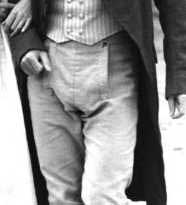
White buckskin inexpressibles, (left) from the 1790s, 
and (right) as worn in the BBC’s production of Sense and Sensibility
(the book was first published in 1811) - small objects not shown

Newland lived on The Bluff, the view from which Edward described so eloquently later in his letter (see my earlier post). I think the “lamper” served by the ascetic couple were lamprey eels. “Inexpressibles”, like “unmentionables”, was a nineteenth century euphemism for trousers, from a time when polite society thought it improper to refer to anything at all below the waist. Poor Edward’s white buckskin riding breeches had become see-through from sweat in the course of his ride, revealing in some detail any small objects contained within them.

Saturday, 19 June 2010

EDWARD DANIEL ACRAMAN (c1825-1848) AND THE HOMESICK BLUES


When my cousin John Acraman, the father of South Australian Football (see my earlier post), first emigrated to Australia in 1848, it was to join his brother Edward.

Edward had been in Adelaide with their uncle Edward Castle since 1846. Back home in Bristol a tea importing venture, Acraman, Bush, Castle and Co, had failed in 1846, and I wonder whether uncle Castle and nephew Acraman hadn’t been dispatched to the Antipodes to try to restore the family fortunes in some way. Both families were merchant venturers, speculative importers and exporters. Australia offered new opportunities for such men with its mineral wealth and vast runs of land for wool production all ripe for exploitation.

Edward Acraman’s letter to his uncle Charles Castle,
18th February 1847

I have one letter written by Edward Acraman. It's to another uncle, Charles Castle, on 18th February 1847. It’s a beautifully written, vivid account of his life in South Australia, full of detailed references to people, places and ships. Over four large sides he describes business proposals (including the partnership with James Cooke by which his brother John made his early fortune), a journey by horse across the outback (of modern day Greater Adelaide!), and his longing for home.

It is as he paints a picture of the dramatic sweep of the coast of Encounter Bay from his vantage point on The Bluff that his expansive mood suddenly changes.

“[We] walked up to the bluff … and after clambering up to the summit, with cautious steps descended to the opposite side, then stealthily crept holding by the rock along a narrow ledge from which a false step would have precipitated us 60 feet on the breakers below on which the vast waters of the Southern Ocean were bursting a silvery foam in the most serene, stilly weather, and at length reached a singular cave which the force of the sea has evidently worn in the cliff at a very remote period, and the view from which surpasses in grandeur perhaps any scene I have witnessed.

“On the right the coast is intersected by numerous small coves, too varied for description & on the left the scene is still more so, the numerous islands, looking but more dark and sombre by contrast with the lights of the native encampments on the opposite shore, the awful gulf beneath, into which one hasty step would plunge the unwary, the skeletons and bones of whales ranged on the beach, the houses & primitive huts scattered on every side, the immense distance of coast, which ‘neath an Australian sky is far more perceptible than an Englishman can well imagine, and the dark thickly wooded hills which frown around, completing one which though interesting in the extreme, causes a feeling of melancholy which will attract many to the same spot, though at the same time, if often prevailing, it would embitter existence.

The Bluff, Encounter Bay, South Australia

“If this dreary be the place I have attempted to describe with the sunny skies of the south Land to relieve it, how much more so would it be with the climate of England. And yet I never felt the desire to return home stronger than at that Bay, it is when looking on the sea, that I in common with many others, hope again to recross it, but duty has ordained otherwise perhaps for years to come. When that event does take place, if it ever will, it can only be with happier prospects than those which hurried me from my native land.”

He snaps out of his blue mood by returning to the subject of business – he is pleased that a ship, the Appleton, is sailing from Bristol and hopes he can fill it with a good return cargo. It is the Appleton which almost exactly a year later brings his brother John out to join him, surviving the worst Southern Ocean gale in living memory on the way. But John, on landing at Port Adelaide a week after the storm, discovers that his older brother has died twelve weeks earlier, during the Appleton’s passage, aged just 22.

The Success, similar in size to the Appleton,
was also caught in the storm of 31st March 1848.
Blown aground and with half her rudder gone,
she was floated off and eventually became a prison hulk.

I don’t know why. Was it sudden? Or was John rushing out to be with him? But poor Edward, so far from home and family, never did get to recross the dark waters back to Bristol.

A happier memory of him in my next post.

Saturday, 12 June 2010

SAMUEL SALTER (1773-1842) AND THE FOUNDING OF LONDON UNIVERSITY


I come from a tightly woven plait of eighteenth and nineteenth century Non-Conformist families. My great great great grandfather Samuel Salter was a deacon of the first Baptist church in Watford before he moved the family into London. There he filled the same office at the Baptist church in Blackfriars Road and became involved in the Baptist Home Missionary Society, which he eventually served as Treasurer.

Like many Non-Conformists, the Baptists believed passionately in education as a way into the mainstream society from which they were largely excluded because of their faith. It was a religious duty to better oneself through learning. But from education too they were excluded, by a system which allowed only members of the Church of England to attend England’s only two universities, Oxford and Cambridge.

London University Share no. 1005

The solution was simple: establish your own university. This they did, and founded the defiantly named London University in 1826. The founders raised the money to build the university through an issue of shares, and I’m proud as anything to record that Samuel Salter bought one!

Admittedly he wasn’t exactly first in line – his share is dated 1828 and numbered 1005 – but it survives to this day in the family archive as a symbol of their commitment to learning. Not only did he buy a share: when the new university opened its doors to students in 1828, the very first intake of students that Michaelmas term included Samuel’s son William Augustus Salter. Salters (and other descendents) have been going to university in every generation since.

London University, 1828
by Thomas Hosmer Shepherd

Because London University applied no religious tests to its entrants, it was not at first granted a charter. Moreover a rival institution was established within a year of the university’s opening – King’s College, founded by King George IV and the Duke of Wellington, was intended like Oxford and Cambridge to admit only Anglican students (although in fact Non-Conformist students could study there and were only barred from sitting exams).

Neither university could confer degrees however, and in order to enable this politically, the two institutions combined under the name the University of London. The original Non-Conformist London University was renamed University College. As UCL it survives to this day, one of nine colleges currently making up the University of London.

For the record, William Augustus Salter studied the following subjects, and his father paid the following fees, during his time at London University:
Matriculation £2
1828-29: Latin £7.10s, Greek £7.10s, Mathematics £7.
1829-30: Latin £7.10s, Greek £7.10s, Hebrew £5.
1830-31: Greek £7.10, Hebrew £5, Logic £5.
William went on to train for the Baptist ministry at Stepney Baptist College (now Regents Park College Oxford) and fought all his life for better education provision for the poor of his several parishes. As a biblical scholar he was also a major contributor to the Annotated Paragraph Bible edited by his brother-in-law Joseph Gurney (see my earlier post).

Samuel retired to Watford. After death he was buried in the Salter Family Vault at the Baptist church in Beechen Grove of which he had been deacon as a younger man. Sad to report, the vault and church were demolished in the 1960s to make way for the Harlequin Shopping Centre. But its contents were re-interred with due respect beneath a simple plaque in Watford’s Vicarage Road Cemetery (opposite the football ground of the same name).

The Salter Family Grave, Vicarage Road Cemetery, Watford
(photographed in February 2008)

It reads: “The remains of those buried between 1721 and 1860 in the graveyard of the original Baptist church, Beechen Grove, Watford were reverently reinterred here in October and November 1963. Further remains being those of David Salter and his family were reinterred here on the 18th March 1974.”
Related Posts Plugin for WordPress, Blogger...