All writing © 2009-2015 by Colin Salter unless indicated otherwise. All rights reserved.
More information at www.colinsalter.co.uk

Saturday, 26 June 2010

EDWARD DANIEL ACRAMAN (c1825-1848) AND HIS INEXPRESSIBLES


My cousin Edward seems to have been sent out to manage the family business in Australia at a time of some crisis in 1846. He died less than two years later at the age of only 22, never having returned home to Bristol, just weeks before his brother John arrived to keep him company.

The little I know of him comes from one long letter he wrote to his uncle, my 3x great uncle Charles Castle, on 18th March 1847. It’s a beautifully written, vivid account of his life in South Australia, full of detailed references to people and places of historical importance in the early years of that nation.

Rev RW Newland (1790-1864)
The Pioneer Pastor

Framed by news of business ventures, the central passage of the letter describes a 100-mile trip on horseback which he made from Adelaide to Encounter Bay, to visit Rev Ridgway William Newland, whom Edward had met on his passage out from Bristol on board the Kingston. Newland, a Congregationalist, was returning from a brief trip back to Blighty, having first emigrated in 1839 in search of religious freedom. Widely known in South Australia as the Pioneer Pastor, Newland was also a local magistrate and a useful contact for a new arrival, especially a fellow Congregationalist such as Edward. Edward’s report of his journey is alive with detail.

“I have visited Encounter Bay, traversing nearly 100 miles on horseback at an expense of 3s/2d, on my way thither passing the fertile district of Maclaren Vale, the rising towns of Noarlunga and Willunga, crossing the Mount Terrible range of mountains, a vast sea of scrub and thirsty swamp and [breaking the journey] at Hungry Swamp. The morass which bears such an unhappy appellation is now adorned by the villa (or villa-nous) residence of an elderly couple of ascetics who derive an ample subsistence by the retailing of Tea and Lamper, the manufacture of besoms from a plant which grows in large quantities in scrubby land, and the cultivation of a small garden, which yields very fine potatoes and which after a long ride are doubly welcome for
‘Who’d go through the scrub
Without any grub?’

Lamprey eels are still eaten along the Minho valley in Portugal,
cooked in a wine and blood sauce
in stove-top casseroles and served with rice

“At 15 miles distance, at a sudden turn in the almost overgrown way, the view of the noble bay burst upon me, the waters of which, generally so troubled, were then still “as an infant asleep”. After fording the mouths of the Hindmarsh and Inman Rivers, two miles of sand were to be passed ere Rozinante and self could reach the residence of the Rev’d R.W. Newland, our quondam fellow passenger of the “Kingston”, to whose paddock the former and whose house the latter were paying a visit when, lo! breath it not in Gath! an awful calamity befell neither the former nor the latter, but alas! his inexpressibles, for being those “rarae aves” white bucks, a ride of 50 miles had rendered them semi-transparent, and the extra exertion required to stimulate the horse during the latter part of the journey completed the catastrophe.

“Fortunately however the mists of night were beginning to shroud the neighbouring hills and by the time of my arrival small objects … were not visible to the naked eye. Having effected a hasty retreat to a private room and as hasty a transformation into younger birds of the same species, … I joined the party with more confidence than at first, and was shortly after occupied in doing my devours (devoirs) on divers slices of ham &c.”

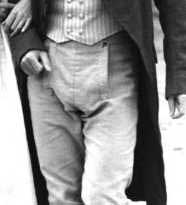
White buckskin inexpressibles, (left) from the 1790s, 
and (right) as worn in the BBC’s production of Sense and Sensibility
(the book was first published in 1811) - small objects not shown

Newland lived on The Bluff, the view from which Edward described so eloquently later in his letter (see my earlier post). I think the “lamper” served by the ascetic couple were lamprey eels. “Inexpressibles”, like “unmentionables”, was a nineteenth century euphemism for trousers, from a time when polite society thought it improper to refer to anything at all below the waist. Poor Edward’s white buckskin riding breeches had become see-through from sweat in the course of his ride, revealing in some detail any small objects contained within them.

Saturday, 19 June 2010

EDWARD DANIEL ACRAMAN (c1825-1848) AND THE HOMESICK BLUES


When my cousin John Acraman, the father of South Australian Football (see my earlier post), first emigrated to Australia in 1848, it was to join his brother Edward.

Edward had been in Adelaide with their uncle Edward Castle since 1846. Back home in Bristol a tea importing venture, Acraman, Bush, Castle and Co, had failed in 1846, and I wonder whether uncle Castle and nephew Acraman hadn’t been dispatched to the Antipodes to try to restore the family fortunes in some way. Both families were merchant venturers, speculative importers and exporters. Australia offered new opportunities for such men with its mineral wealth and vast runs of land for wool production all ripe for exploitation.

Edward Acraman’s letter to his uncle Charles Castle,
18th February 1847

I have one letter written by Edward Acraman. It's to another uncle, Charles Castle, on 18th February 1847. It’s a beautifully written, vivid account of his life in South Australia, full of detailed references to people, places and ships. Over four large sides he describes business proposals (including the partnership with James Cooke by which his brother John made his early fortune), a journey by horse across the outback (of modern day Greater Adelaide!), and his longing for home.

It is as he paints a picture of the dramatic sweep of the coast of Encounter Bay from his vantage point on The Bluff that his expansive mood suddenly changes.

“[We] walked up to the bluff … and after clambering up to the summit, with cautious steps descended to the opposite side, then stealthily crept holding by the rock along a narrow ledge from which a false step would have precipitated us 60 feet on the breakers below on which the vast waters of the Southern Ocean were bursting a silvery foam in the most serene, stilly weather, and at length reached a singular cave which the force of the sea has evidently worn in the cliff at a very remote period, and the view from which surpasses in grandeur perhaps any scene I have witnessed.

“On the right the coast is intersected by numerous small coves, too varied for description & on the left the scene is still more so, the numerous islands, looking but more dark and sombre by contrast with the lights of the native encampments on the opposite shore, the awful gulf beneath, into which one hasty step would plunge the unwary, the skeletons and bones of whales ranged on the beach, the houses & primitive huts scattered on every side, the immense distance of coast, which ‘neath an Australian sky is far more perceptible than an Englishman can well imagine, and the dark thickly wooded hills which frown around, completing one which though interesting in the extreme, causes a feeling of melancholy which will attract many to the same spot, though at the same time, if often prevailing, it would embitter existence.

The Bluff, Encounter Bay, South Australia

“If this dreary be the place I have attempted to describe with the sunny skies of the south Land to relieve it, how much more so would it be with the climate of England. And yet I never felt the desire to return home stronger than at that Bay, it is when looking on the sea, that I in common with many others, hope again to recross it, but duty has ordained otherwise perhaps for years to come. When that event does take place, if it ever will, it can only be with happier prospects than those which hurried me from my native land.”

He snaps out of his blue mood by returning to the subject of business – he is pleased that a ship, the Appleton, is sailing from Bristol and hopes he can fill it with a good return cargo. It is the Appleton which almost exactly a year later brings his brother John out to join him, surviving the worst Southern Ocean gale in living memory on the way. But John, on landing at Port Adelaide a week after the storm, discovers that his older brother has died twelve weeks earlier, during the Appleton’s passage, aged just 22.

The Success, similar in size to the Appleton,
was also caught in the storm of 31st March 1848.
Blown aground and with half her rudder gone,
she was floated off and eventually became a prison hulk.

I don’t know why. Was it sudden? Or was John rushing out to be with him? But poor Edward, so far from home and family, never did get to recross the dark waters back to Bristol.

A happier memory of him in my next post.

Saturday, 12 June 2010

SAMUEL SALTER (1773-1842) AND THE FOUNDING OF LONDON UNIVERSITY


I come from a tightly woven plait of eighteenth and nineteenth century Non-Conformist families. My great great great grandfather Samuel Salter was a deacon of the first Baptist church in Watford before he moved the family into London. There he filled the same office at the Baptist church in Blackfriars Road and became involved in the Baptist Home Missionary Society, which he eventually served as Treasurer.

Like many Non-Conformists, the Baptists believed passionately in education as a way into the mainstream society from which they were largely excluded because of their faith. It was a religious duty to better oneself through learning. But from education too they were excluded, by a system which allowed only members of the Church of England to attend England’s only two universities, Oxford and Cambridge.

London University Share no. 1005

The solution was simple: establish your own university. This they did, and founded the defiantly named London University in 1826. The founders raised the money to build the university through an issue of shares, and I’m proud as anything to record that Samuel Salter bought one!

Admittedly he wasn’t exactly first in line – his share is dated 1828 and numbered 1005 – but it survives to this day in the family archive as a symbol of their commitment to learning. Not only did he buy a share: when the new university opened its doors to students in 1828, the very first intake of students that Michaelmas term included Samuel’s son William Augustus Salter. Salters (and other descendents) have been going to university in every generation since.

London University, 1828
by Thomas Hosmer Shepherd

Because London University applied no religious tests to its entrants, it was not at first granted a charter. Moreover a rival institution was established within a year of the university’s opening – King’s College, founded by King George IV and the Duke of Wellington, was intended like Oxford and Cambridge to admit only Anglican students (although in fact Non-Conformist students could study there and were only barred from sitting exams).

Neither university could confer degrees however, and in order to enable this politically, the two institutions combined under the name the University of London. The original Non-Conformist London University was renamed University College. As UCL it survives to this day, one of nine colleges currently making up the University of London.

For the record, William Augustus Salter studied the following subjects, and his father paid the following fees, during his time at London University:
Matriculation £2
1828-29: Latin £7.10s, Greek £7.10s, Mathematics £7.
1829-30: Latin £7.10s, Greek £7.10s, Hebrew £5.
1830-31: Greek £7.10, Hebrew £5, Logic £5.
William went on to train for the Baptist ministry at Stepney Baptist College (now Regents Park College Oxford) and fought all his life for better education provision for the poor of his several parishes. As a biblical scholar he was also a major contributor to the Annotated Paragraph Bible edited by his brother-in-law Joseph Gurney (see my earlier post).

Samuel retired to Watford. After death he was buried in the Salter Family Vault at the Baptist church in Beechen Grove of which he had been deacon as a younger man. Sad to report, the vault and church were demolished in the 1960s to make way for the Harlequin Shopping Centre. But its contents were re-interred with due respect beneath a simple plaque in Watford’s Vicarage Road Cemetery (opposite the football ground of the same name).

The Salter Family Grave, Vicarage Road Cemetery, Watford
(photographed in February 2008)

It reads: “The remains of those buried between 1721 and 1860 in the graveyard of the original Baptist church, Beechen Grove, Watford were reverently reinterred here in October and November 1963. Further remains being those of David Salter and his family were reinterred here on the 18th March 1974.”

Saturday, 5 June 2010

JOSEPH GURNEY (1804-1879) AND THE ANNOTATED PARAGRAPH BIBLE


Joseph Gurney was my great great great uncle. He followed his father and grandfather in the office of Official Shorthand Writer to the Houses of Parliament, using the Gurney shorthand system invented by his great grandfather Thomas Gurney.

Joseph Gurney (1804-1879),
communicator of government and gospel

The Gurneys were Non-Conformists by faith. Baptists (and other Christian churches not aligned with the Church of England) were emerging in the nineteenth century from the shadows of intolerance and marginalisation, driven by radical religious zeal and a passionate belief in education. Disenfranchised, they had a hunger for god and knowledge which the establishment Church of England had rather lost sight of over the centuries.

Joseph managed to combine his zeal for both heaven and learning through his fifty years of membership of the Religious Tract Society, an organisation founded in 1799 and committed to spreading the Word of God in print, particularly to children, women and the poor.

The Lord’s Prayer for Little Children,
published by the Religious Tract Society, 1870

An active member from the moment he joined in 1829, Gurney became a trustee and in due course the Society’s treasurer. He was a biblical scholar, and when it became clear that the laws on publishing the Bible were not as restrictive as previously imagined, he determined that the Society should publish its own edition.

What seems blindingly obvious and commonplace to us now was Gurney’s inspired innovation. Guided by the Society’s core ethos of making religious text accessible to the masses, he introduced two very simple ideas. Up until then Bibles had been huge, family-sized volumes, solemn and severe with column after column of uninterrupted text. Gurney’s Bible, the Pocket Paragraph Bible, was small enough to fit in your pocket so that you could carry it everywhere with you; and for the first time the text was divided into paragraphs, making it easier to follow and less overwhelming on the page. It appeared in 1846, and was so well received that it became the standard prize for Religious Knowledge given by School Boards throughout the country for decades to come.

Buoyed by the success of the Pocket Paragraph, Joseph Gurney set to work on his next brilliantly simple biblical novelty – explanatory notes, designed to assist further with understanding God's word and will. He enlisted the help of many linguistic and biblical experts, who laboured for ten years in willing anonymity on the new project and like Gurney himself without pay. It was published in sections between 1850 and 1860, when the first complete edition of the Annotated Paragraph Bible appeared.

Paragraphs, notes, and a plan of Solomon’s Temple
Title page of the New Testament, with a handy pull-out map of Palestine

It was a towering academic and spiritual achievement, an instant success which was widely and quickly translated into many languages for the benefit of the hundreds of Non-Conformist missionaries working overseas from Africa to the Far East.

The Annotated Paragraph used the classic King James Version of the Bible which was first published in 1611. Gurney’s next Big Idea was to dispense with explanatory notes and instead update the text itself, with a new translation. With the assistance of eminent Greek and Hebrew scholars of the day, he published the Revised English Bible in 1877, eight years before the Church of England’s officially sanctioned Revised Standard Version.

Joseph Gurney died on 12th August 1879, just two weeks after the death of his brother-in-law and lifelong friend, my great great grandfather William Augustus Salter. Salter was a Baptist minister and brilliant Greek and Hebrew scholar. He had been, so Gurney’s obituary revealed, one of the major contributors to the Annotated Paragraph Bible.

“In a memoir of one [wrote the obituarist] it is impossible not to name the other of these true brothers, who after years of intimate correspondence on the word of God, departed almost hand in hand, death dividing them  for only a few weeks, to continue their study of truth in the all-revealing light of their Saviour’s presence.”

The single-volume edition of
Joseph Gurney’s Annotated Paragraph Bible, 1860

In the year of their death the Religious Tract Society began publication of its long-running magazine of stories and improving articles, The Boys' Own Paper! Salter's son William Henry Gurney Salter succeeded Joseph in the post of Parliamentary Shorthand Writer.

Saturday, 29 May 2010

JOHN ACRAMAN (c1829-1907) AND THE ROOTS OF SOUTH AUSTRALIAN FOOTBALL


The Acramans are cousins of ours – John Acraman’s mother Mary Castle was my great great grandfather’s sister. They were a successful Bristol family with interests in merchant shipping and ironworks – John’s father made ships’ anchors and chains amongst other things. Acraman’s warehouse on the quay at Bristol still stands, and now houses the Arnolfini Gallery in the city.

John Acraman, sheep-farmer and sportsman (c1829-1907)

A Bristol tea-importing venture, Acraman, Bush, Castle & Co, failed in 1846; and John emigrated to Australia in 1848 to build the family’s business interests in Adelaide. In the partnership of Acraman, Cooke & Co he built a thriving import-export business. In 1854 he formed Acraman, Main and Lindsay which operated four coastal ships and a relatively small sheep-farm (around 30,000 head) on two areas or "runs" on the Eyre peninsula, called Gum Flat and Maryvale (the latter named after his mother).

He later moved his operations to a vast area further west, where his two holdings (called Yardea and Wilgena) covered in total some 2,200 square miles. Yardea alone cost £50,000 to develop because of the need to install wells and fences. At the height of his success he and his partners were sheering around 150,000 sheep. Changes in the law about land ownership in the 1884 Crown Lands Act substantially reduced the size of the runs and eventually he withdrew from the industry and became a pillar of the Adelaide business community. His name survives in the landscape in Lake Acraman, a crater lake north-west of Adelaide, and in Acraman Creek Conservation Park on the coast south-west of the lake.


Back in 1854 one of John’s early imports into the colony had been a consignment of five footballs. It is clear that this was no mere business decision and that he was himself a keen footballer: in 1860 he met other interested parties at the Globe Inn in Adelaide to discuss the establishment of a local football club, of which he was (in the early games of its existence) player-captain. He became in time president of the Adelaide Football Club, and on its formation in 1877 a vice-president of the South Australian Football Association. In 2002 he was one of the inaugural inductees into the South Australian Football Hall of Fame, which describes him as the Father of South Australian Football.

Saturday, 22 May 2010

AUSTIN COOPER (1802-1838), THE TITHE WAR AND THE BACK-TO-BACK TRAP


This is No.4 in my infinite and occasional series of Austin Coopers. It could also form part of a Tall Tales From The Trees mini-series on assassination. Elsewhere in this blog I’ve written about John and William Gurney, who were both caught up in attempts on the lives of British Prime Ministers. This Austin however (my great great grandmother’s brother) was himself murdered. By mistake, so the story goes, although having read round it a little, I’m not convinced.

A modern-day back-to-back trap
(this one from Denver, CO)

Austin, a Protestant bishop, was on his way to Tipperary Fair in a back-to-back trap (one in which two passengers faced forward and two backwards). His cousin and neighbour Francis Wayland sat beside him and his brother Samuel held the reins. All three were armed, as well they might be. They were all powerful landowners in the area, part of the protestant settler class who had ruled over the native population, in some cases for hundreds of years but in few cases by popular acclaim.

Since 1823, when Daniel O’Connell had formed the Catholic Association to campaign for Catholic electoral rights, unrest had become more active and deliberate. Rents at the time were in the form of tithes to the Protestant Church, a system which the Catholic peasants naturally resented and against which they fought the so-called Tithe War, a campaign of non-payment and violent protest. The Protestant powers responded by simply evicting unruly tenants. With no further redress within the law, frustrated Catholics turned to more direct ways of making their grievances heard.

"When a tenant is removed," said the Devon Commissioners, describing Tipperary in 1845, "he is looked upon as an injured man, and the decree too often goes out for vengeance upon the landlord or the agent, and upon the man who succeeds to the farm; and at times a large numerical proportion of the neighbourhood look with indifference upon the most atrocious acts of violence, and by screening the criminal, abet and encourage the crime. Murders are perpetrated at noon-day on a public highway; and whilst the assassin coolly retires, the people look on, and evince no horror at the bloody deed."

Withholding tithes from a Protestant minister
(19th century cartoon)

On the 5th April, 1838, somewhere between Ballinaclough and Greenane on the back road from Golden to Tipperary, the trap was ambushed. Reports vary, but between three and eight men with blackened faces leapt out from concealment below the roadside and opened fire. Austin was killed immediately, and Wayland died later from a fatal bullet wound in his back. Samuel returned fire, fatally wounding one of the attackers, and made his escape.

When I visited Austin Cooper’s old mansion about ten years ago, the owners (no longer Coopers) told me that he had been shot by mistake as he stood up in the trap to take off his coat. But Wayland’s father George had in April 1837 put out a farmer called Thomas Ryan, and Francis himself had evicted a William Ryan for being £15 in arrears on a rent of £45. Cooper too had recently evicted several tenants and, even if Wayland was the intended target, I don’t suppose the assassins much regretted the “mistake” of catching Cooper in the crossfire.

It was during the harsh winter of early 1838, when those evicted were suffering cruelly, that various members of the Ryan family hatched the plot to “meet” Wayland. Other men were involved, including Cornelius Hickey and William Walsh, two local carpenters. During the manhunt which followed the assassination, at least three men were arrested: Hickey, Walsh and another man who died during custody. In the run up to the trial, George Wayland (and perhaps Sam Cooper too) received death threats by post, and shots were fired at his house in an attempt to get him to drop the charges and release the suspects.

The Main Guard, Clonmel’s courthouse

On 17th January 1839 Hickey and Walsh were convicted of the murders by a special jury and they were hanged outside Clonmel Prison twenty days later on Wednesday, February 6th. A plaque today marks the spot where the gallows stood, and commemorates the “many notable patriots” imprisoned there. In 1838, the year of their crime, tithes were abolished and a system of fixed rents introduced.

Some of the information in this article comes from Butterhill and Beyond, a Cooper family history by another Austin Cooper, Richard Austin-Cooper.

Saturday, 15 May 2010

GEORGE ADAM BAYLEY (1845-1876) AND THE HURDLING GOLD


The Bayley family, who followed the yellow brick road of the industrial revolution to become prosperous Lancashire mill owners, were of eighteenth century farming stock. They were noted not only for their business acumen (wrote an early twentieth century Stalybridge historian) but also for “their exceptionally fine physique and love of all field sports.”

Racing over hurdles, Brompton
(from The Graphic magazine, 1871)

George Adam Bayley, a cousin and contemporary of my great grandmother’s, inherited the genes of his father William, of whom it was written “in physique he had few equals and no superiors”; of his grandfather Joseph, “a finely built and handsome man, a daring horseman”; and of his great grandfather Joseph, “a fine and powerful man.”

Adam was a keen amateur athlete, a noted swimmer, wrestler, runner and jumper. At a great Athletic Festival held in Manchester, 29th July, 1865, open to all comers, his record was as follows: cleared the bar at 9 feet 9 inches in the pole-jump; covered a distance of 18 feet 5I inches in the long jump; cleared at a stand jump 9 feet 9 inches; won the 220 yards hurdle race easily; and threw the cricket ball a distance of 105 yards. Nobody throws the cricket ball any more (except cricketers of course), but when I was a lad it was one of the central events of the school sports day.

For his wonderful feats that day Adam was awarded a silver medal for pole-jumping, silver medal for long jumping, and gold medal for running and jumping. I’m afraid none of the Bayleys’ athletic prowess has come down to me or any of my siblings. My brother and I are tall and had legs long enough for the high jump to be easy at junior school, but that was as far as we went with sport. 

My father had an arrhythmic heart condition that forced his withdrawal from sports activities at his school, something he always regretted. He turned to academia. His father’s generation were keen alpine climbers, but  by day white collar professonals of one sort or another - lawyers and historians. In general we have been all thinkers rather than doers, whose genes apparently (and ironically) overpowered those of the strapping Bayley lads.

Saturday, 8 May 2010

WILLIAM BAYLEY (1802-1891) AND THE PLUG RIOTS


My Bayley family tree is a perfect illustration of Britain’s nineteenth century social journey. The Lancashire family moved from their eighteenth century farming roots in Hooley Hill to the rapidly expanding cotton industry of the Lancashire towns.

(Hooley Hill was a sizeable village which took to the industrial revolution with gusto, becoming a centre for felt hat production – although I haven’t read this anywhere else, it seems a possibility that Hooley gave its name to special occasions at which a hat might be worn, parties for example, or as they became known in Ireland, hooleys! Does anyone know different?)

William Bayley, unplugged

The Bayleys moved to nearby Stalybridge. William Bayley, first cousin of my great great grandmother Ellen Bayley, was two years old when his father built their first mill there in 1804 – Bridge Street Mill. After the death of his father in a horrific mill accident, he and his brothers developed the family business as Wm Bayley and Brothers in what became known as the Bayley Street Mills.

In 1841 an economic depression brought reduced hours to the Lancashire Mills as it did to the rest of Britain. Hard times and discontent drove up popular support for the Chartists, who were agitating for radical electoral reform. Things came to a head in the hot summer of 1842 when wage cuts were threatened. The fury of the workforce made most mill owners reconsider, but William Bayley imposed a sixpence reduction (2.5p) on a weekly wage of ten and ninepence (53.5p), nearly 5%. Anger erupted in protest meetings and a general strike of mill workers.

A plug riot: this one in Preston, August 1842

When William offered to withdraw the cuts a few days later it was too late; the Chartists were fanning the flames and the strike spread. Nationally half a million people withdrew their labour. In Lancashire mobs went from mill to mill stopping the machinery, by force if they had to. In some cases the rioters broke in and sabotaged the works by removing plugs from the boilers, and the actions became known as the Plug Riots.

By the end of September it was all over and most strikers had returned to work at the old rates of pay. Although the Chartists never again attracted such levels of support, the strike is a landmark event in the history of labour rights, and Friedrich Engels specifically referred to Stalybridge in writing “The Condition of The Working Class in England” two years later.

William Bayley’s role in starting it all doesn’t seem to have done him any lasting political damage. The Municipal Borough of Stalybridge received its charter of incorporation on 5 March 1857, and Bayley was elected its first mayor, serving for three years.

Clarence Mill on the Macclesfield Canal,
now Bollington Discovery Centre

The Bayley brothers subsequently fell foul of another economic crisis. War with the US in 1862 resulted in a critical shortage of cotton and mass redundancies across the Lancashire mills. In Stalybridge only five of over 60 factories and workshops were working at full strength; 7000 workers were unemployed, and an exodus in search of other work left 750 houses in the town empty. The Bayleys had committed to a new state of the art factory, Clarence Mill, and lost heavily on its construction. Some reports say the Bayleys never used the building, and they certainly sold it off only a few years later. William, by now over 60, withdrew from the business in 1863 and led a long and comfortable retirement in his mansion Stamford Lodge.

William's life, almost exactly spanning the nineteenth century, mirrors Britain's industrial development. He experienced all the twists of its story: its rise to strength and the threats to its viability. As a prominent mill owner he played in equal measure the part of wicked employer and that of local benefactor, donating money to local churches and to the building in 1854 of Bayley Street bridge, which connected his mills and the town to new roads and a wider world.

Saturday, 1 May 2010

CHARLES CASTLE (1813-1886) AND A TOWN CALLED KIRKLAKE


I inherited the contents of my 3x great uncle Charles’ writing desk a few years ago. They are an amazing survival – 150-year old bundles of correspondence, sometimes complete exchanges including not only letters received but the draft versions of his replies to them.

One such bundle, an exchange of eight letters between Castle and a Whig called Charles Thompson, deals with his hopes of becoming a Liberal candidate in the 1857 general election. Parliament had been dissolved when the coalition government of the day collapsed in disagreements about the Second Opium War (see my recent post on Sir John Bowring). The Prime Minister Lord Palmerston, a Liberal, had lost a censure debate on 3rd March over his support for Bowring (the governor of Hong Kong) and Parkes (Bowring’s Canton counterpart) and called a snap election for 30th April.

When the Tory motion of censure was carried, Palmerston portrayed it as a vote to “abandon a large community of British subjects at the extreme end of the globe to a set of barbarians - a set of kidnapping, murdering, poisoning barbarians.” (Bowring’s wife had been poisoned by a Chinese baker.) Only six years after the triumphant (and triumphalist) Great Exhibition, popular sentiment was with Palmerston and the Empire.

Charles Castle (1813-1866),
letter writer, Whig activist

Charles, a Bristol man, was a natural Liberal, a Unitarian by religion, and he must have fancied his chances when within a week of the censure his friend Mr Hunt proposed him as a candidate of Liberal principles in the Bridgwater constituency. The Borough returned two MPs and hopes were running high that they could both be Whigs (the predecessors of the Liberal Party) for the first time since the general election of 1835.

But first, there was a Committee to get past, and that Committee had set up a Sub-Committee to draw up a short list … For all his Liberal virtues, Charles was an impatient man. Accustomed to getting his own way, he was irritated by the Committee’s delay in selecting a candidate even by a day, writing “I trust they will be able to justify themselves to the Electors. If invited now, which I confess I do not expect, I should feel bound to approach a contest with some caution.”

Four days later, Castle heard that he was not selected. Worse, Mr Otway, the local man chosen over him, declined to stand after all. With time running out, the Bridgwater Liberals opted for a celebrity candidate, a popular travel writer and historian called Alexander William Kinglake who had unsuccessfully contested the seat in 1852. When in spite of being rejected Castle offered to lend his forceful support, Henderson assured him that there was no need – “if we have fair play we are sure to win, and if our opponents want to have [corrupt] practices, why they must take the consequences. … We are such a majority on the Register that we have no need to imperil our cause.”

Alexander William Kinglake (1809-1891)
historian, travel writer, MP

Bridgwater elected two Whig members in 1857 – Kinglake and Charles Kemeys-Tynte. Kinglake was returned at next two general elections, but the result of the 1868 general election in Bridgwater was voided on petition on 26 February 1869 because of Liberal malpractice. No by-election was held, and after a Royal Commission found that there had been extensive corruption by both Whigs and Tories, the town was disenfranchised in 1870 and incorporated into the West Somerset constituency. It was reinstated in 1885. But 140 years later, boundary changes see it once again subsumed in the single “Bridgwater and West Somerset” ward in time for the 2010 general election.

Perhaps Kinglake was distracted by his other career. His magnum opus was his “Invasion of the Crimea,” in 8 volumes, published from 1863 to 1887, described on Wikipedia as one of the most effective works of its class. It has been accused of being too favourable to Lord Raglan, and unduly hostile to Napoleon III, for whom the author had an extreme aversion. But it was popular enough for the timber town of Kinglake in Victoria, Australia (2006 population 1482), to be named after him a year after the publication of the final volume.

Kinglake, Victoria
Black Saturday, 7th February 2009

I’m not sure why – neither he nor the Crimea seems to have any other connection with the town, the state or the continent. The town in turn lent its name to a huge forest National Park established in 1928. Both town and park were devastated by bushfires on 7th February, Black Saturday, in 2009. 98% of the forest was destroyed and over 100 lives were lost in the town.

For Charles Castle, that last note from Charles Thompson, confirming that not only Mr Otway but also Mr Kinglake and a Mr Follett had been picked ahead of him, marked the end of his active involvement in politics as far as I know. Charles Thompson (1815-1889), a fellow Unitarian whose ancestors had been Quakers, moved to Cardiff later that year with his family and became chairman of Spillers Flour Mills. Cardiff’s Thompson Park was donated to the city by his son (also Charles).

Charles Thompson’s final note to Charles Castle
confirming the choice of Liberal electors for candidates,
28th March 1857
Related Posts Plugin for WordPress, Blogger...