All writing © 2009-2015 by Colin Salter unless indicated otherwise. All rights reserved.
More information at www.colinsalter.co.uk

Saturday, 30 April 2011

AUSTIN COOPER (1890-1964) AND THE OLD MARKET-PLACES OF ENGLAND

I wrote about my cousin Austin Cooper once before. He was Canadian, but served with the Black Watch Regiment during the First World War. With them he went through four years of trench warfare in some of the grimmest confrontations of the conflict including Passchendaele and Ypres. At the latter he survived a gas attack which killed many of the 60,000 Canadians lost in the war.

Austin Cooper was discharged in 1919
with the rank of Regimental Sergeant Major

In peacetime Austin was an artist. Between the wars he settled in England and made his mark as a poster designer, mainly for transport operations such as London Underground and the London Midland and Scottish Railway Company. For my money his best work was for the London and North Eastern Railway, LNER.

In later years he moved towards modernism and cubism, and eventually gave up poster design altogether in favour of completely abstract paintings. But in the 1920s and 1930s he produced several series of themed travel posters for the company including one for literary destinations called The Booklovers’ Britain, and this one, Old World Market-Places.


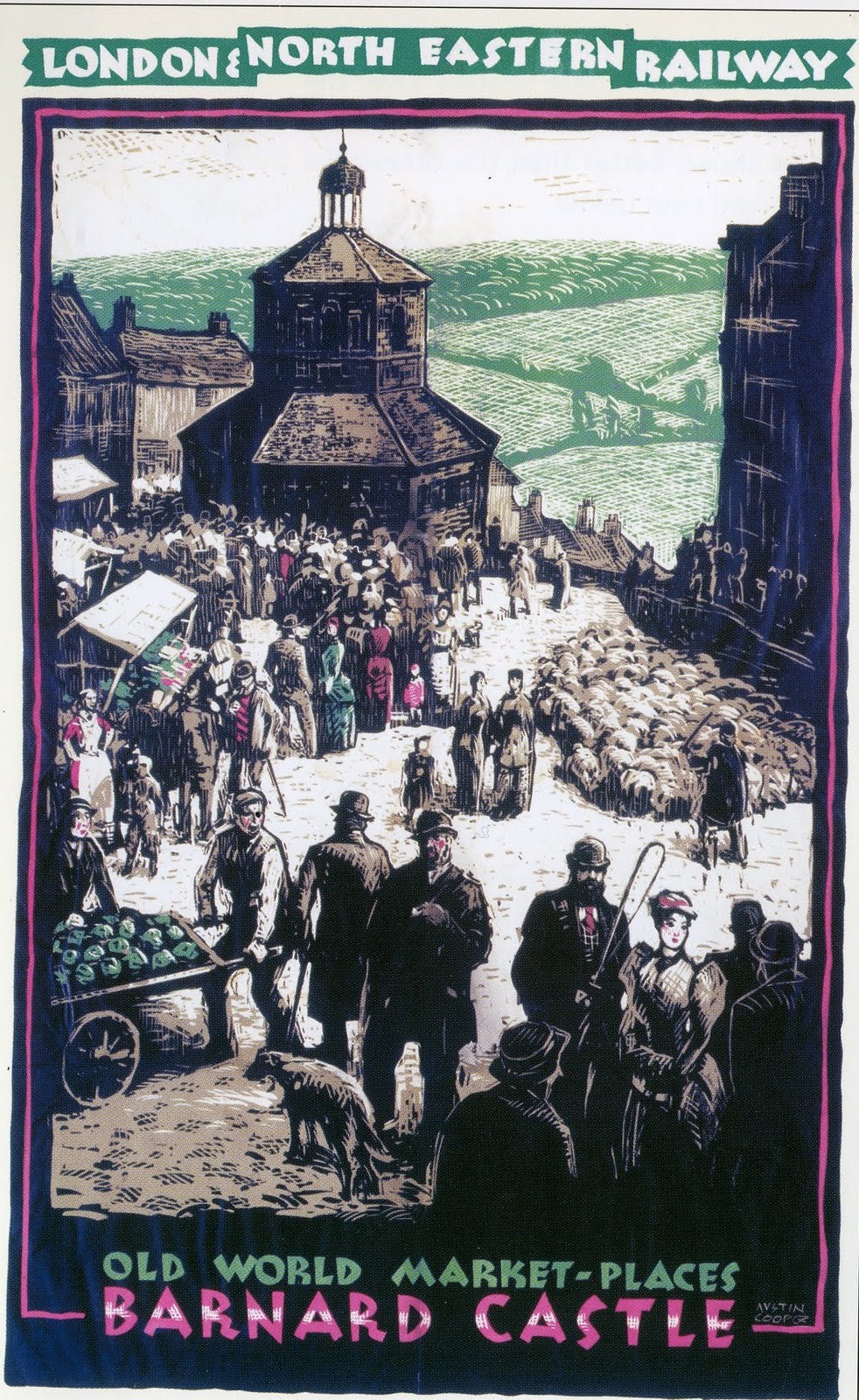
Old World Market-Places, 1927
Norwich, Boston, Barnard Castle and Knaresborough

It’s a beautiful set of stylized woodcuts, a nod to a medium recently repopularised by Noel Rooke and others. Cooper was a master of the type face too, and I think his design here particularly suits the graphic style of the images.

I don’t know whether there were any more destinations in the series. The Upper Teesdale line which served Barnard Castle is long gone. But Boston, Norwich and Knaresborough all still have railway stations. I'm a sucker for a market town, and all four (and particularly my soft spot Barney, as we used to call it) are still well worth the trip that Austin Cooper’s artwork was urging over 80 years ago.

Saturday, 23 April 2011

SIR RALPH SADLEIR (1507-1587) AND THE V.I.P. (PART TWO)


In 1584, my poor old 12x great uncle Ralph Sadleir was hauled out of statesmanlike semi-retirement by Queen Elizabeth I to fill the post of gaoler to Mary Queen of Scots at Sheffield Castle – a Very Important Prisoner indeed. Unfortunately for him his military and administrative prowess, his familiarity with Mary’s ways and above all his unswerving loyalty to his own Queen made him the obvious man for the job. At the age of 77, only his years of active service can have given him the strength to prepare himself and 43 of his own men for the weeklong ride north from his home at Standon in Essex, just outside London, to the small provincial town of Sheffield.

Sir Ralph Sadleir (1507-1587)
statesman, gaoler and hawking enthusiast

The journey exhausted him, but barely a week later he was on the move again, to Wingfield Manor fifteen miles away. It was not a suitable prison: Ralph declared that he would rather defend Sheffield Castle with 60 men than Wingfield Manor with 300. But Sheffield was swarming with conspirators, and Mary’s chains of communication with them needed to be broken. The transfer of his own retinue and the 47 staff and servants of Mary’s household took a full day: Ralph was bone-weary, and Mary, 35 years his junior, suffered badly from gout.

Wingfield Manor, Derbyshire
exposed to the elements

Wingfield was cold and damp, east-facing on heights above the River Amber in Derbyshire and exposed to harsh winds at the onset of winter. Despite Elizabeth’s assurances that Ralph’s was, in view of his age, a temporary appointment, he and Mary remained at Wingfield for four months. They were virtually prisoners of each other while Elizabeth tried to find a more permanent gaoler. Both Mary’s and Ralph’s health declined during their time at Wingfield.

In desperation Sir Ralph arranged yet another transfer in January 1585, to Tutbury Castle, a two-day winter journey away in Staffordshire. Tutbury was considerably more secure than Wingfield; and Sadleir was able to address its many short-comings of comfort because as part of the Duchy of Lancaster, the castle was under his own control. As winter turned to spring he allowed Mary, who shared his passion for hawking, to join him on days of sport beyond the castle walls.

Tutbury Castle, Staffordshire
a good base for days out

In spite of what might be called their professional relationship – she a captive Scottish queen, he an English queen’s gaoler – they were fellow travelers. Ralph had held the baby Mary in his arms 43 years earlier; and both must have sensed on some level that they were coming to the end of their respective roads. Mary was running out of options, Ralph simply running out of years.

When in April 1585 Elizabeth finally found a successor to Sir Ralph, it was Sir Amyas Paulet, a strict Protestant who allowed Mary none of the comfort, freedom and friendship she had enjoyed with my uncle. Within a year she was embroiled in the Babbington plot which led to charges of her conspiracy against Elizabeth. The commission which eventually signed her death warrant included a loyal but heavy-hearted Sir Ralph, unable and unwilling to protect his friend when she threatened his queen. Mary was beheaded on 8th February 1587. Sir Ralph died of natural causes on 31st March, less than two months later.

 
The tombs: Mary Queen of Scots in Westminster Abbey
and Sir Ralph Sadleir in Standon

“Our Man in Scotland,” Humphrey Drummond’s biography of Sir Ralph Sadleir, from which I learned a lot about Uncle Ralph’s time with Mary, is now out of print but very much worth tracking down secondhand.

Saturday, 16 April 2011

SIR RALPH SADLEIR (1507-1587) AND THE V.I.P. (PART ONE)

V.I.P. in this case stands for Very Important Prisoner. My 12x great uncle Ralph served under four monarchs, in some of the highest offices in the land – at the end of his career he was Queen Elizabeth’s Treasurer and Privy Counsellor. After his retirement, one of his very last duties for the Virgin Queen was as the reluctant gaoler of Mary Queen of Scots.

Sir Ralph Sadleir (1507-1587)
soldier and statesman

Sir Ralph had known Mary almost all her life, having been dispatched by Henry VIII to Scotland to arrange her marriage to Henry’s son Edward, Prince of Wales in March 1543 when Mary was less than four months old. Shown the baby at Linlithgow Palace that month, Sadleir had declared, “It is as goodly a child as I have ever seen of her age.” But when war broke out between England and Scotland later that year, Ralph served his English monarch loyally in what became known as the “rough wooing” of the Scots. For his part in the crushing defeat of the Scottish army at the Battle of Pinkie Cleugh in 1547 Sir Ralph received his knighthood.

Although Mary was crowned in 1543, (her father James V having died when she was just six days old,) Scotland was ruled by regents throughout her minority. When the last of them, Mary’s mother Mary of Guise, died in 1560, Mary took charge and refused to ratify the Treaty of Edinburgh negotiated that year by Sir Ralph and others. The treaty was intended to force Scotland to end its alliance with Catholic France and to recognise Elizabeth I as queen of Protestant England. But Catholics regarded Elizabeth as illegitimate; and as Elizabeth’s Catholic cousin, Mary (by now Queen consort of Francis II of France) was next in line.

Francis II, King of France, King consort of Scots,
and Mary, Queen of Scots, Queen consort of France
c1558, after Francis Clouet

Mary’s desire to unite the thrones of Scotland and England under her own Catholic regime dominated the rest of her life. She was the focus of innumerable plots to that end, by Catholic factions and nations as interested in their own agendas as in hers. For his part Sir Ralph was a religiously tolerant man, but implacably opposed to any move which might result in the surrender of English sovereignty, especially to the French.

When Mary fled to England in 1568 following her forced abdication of the Scottish crown, she became a big political problem. Civil War was a distinct possibility, and in 1569 Sir Ralph was dispatched to squash a Catholic rebellion by the Northern Earls of Westmorland and Northumberland. Mary meanwhile was being moved from castle to castle to keep her out of reach of conspirators and rescuers. She was a compulsive plotter, always planning new schemes and alliances to restore her to one throne or other. The job of gaoler to Mary Queen of Scots was a stressful one, only made possible by a network of vigilant spies and counter-spies.

Sheffield Castle (now demolished)
as it looked in 1819

In 1584, poor old uncle Ralph was hauled out of statesmanlike semi-retirement by Elizabeth I to fill the post temporarily at Sheffield Castle in Yorkshire. Unfortunately his military and administrative prowess, his familiarity with Mary’s ways and above all his unswerving loyalty to his own Queen made him the obvious man for the job. At the age of 77, only his years of active service can have given his the strength to prepare himself and fifty of his own men for the week-long ride north from his home at Standon in Essex, just outside London, to the small provincial town of Sheffield.

How would the man, whom Mary Queen of Scots had described 12 years earlier as “grave and ancient,” fare when pulled back into her world of intrigue? Come back next week and find out!

Saturday, 9 April 2011

CHARLES CASTLE (1813-1886) AND THE TENANT FARMER’S PLEA

I inherited the contents of Captain Charles Castle’s writing desk. Charles was my 3x great uncle and I have hundreds of letters sent to him, with drafts of many of his replies. Such a wealth of personal material paints a pretty rounded portrait of a complicated man, with a finger in many political and economic pies.

He was a Bristol man, from a wealthy old family, and it is not surprising to learn, on the evidence of one letter, that he owned property across the River Severn in Wales. In fact he owned, according to a registry of 1873, around 750 acres in Cardiganshire. This is a portrait of one of his correspondents, from the desperate appeal of widower David Edwards, a tenant farmer whom Captain Castle had given notice to quit.

 
David Edwards’ letter of 12th April 1859

Merthyr Tydfil
12th April 1859
Capt’n Castle
Dear Landlord,

do you determined not allow me remain in the farm after this year, you well know that I made a great improvement since I taken this, to say in short if you please give 14 years time I will give you £50 rent yearly, as I told you before we the children and myself are very angry to depart and another thing I do not believe you will get so much rent, I can pay more rent than some of whom made an enquiry to you for the farm, and I shall engage to put the bounds between us and within in good repair that nothing committed a trespass from my land to Wstrws and that you will have no accation [sic] to trouble yourself hereafter about the tenants of Wstrws and Clawddmelyn so long as the time above lasted & much humbly beg on you of send me your reply forthwith, if you please not consented to my desire I must look for another place ellswere which I do show you I and the children are very across to do so. I had a business here to day and I shall go from here this afternoon for Carmarthen to night.

I am dear Landlord
yours very truly
and [illegible word]ly
David Edwards

Capt’n Castle

PS if you please send the answer by return it will reach my residence so soon as myself. DE

This simple heartfelt letter is full of clues to its context, if not to the actual identity of its sender: David Edwards is one of the commonest names in Wales. Mr Edwards, I am guessing, was a Welshman and not a native English speaker. I am guessing too that there had been some trouble with livestock escaping from his farm and bothering the neighbouring tenants of Wstrws and Clawddmelyn. Perhaps complaints from them had led to his eviction. Wstrws and Clawddmelyn are farms at either end of the village of Capel Cynon, where Captain Castle held around 300 acres of land. I don’t know the name of Mr Edwards’ tenancy, but it would make sense if it were Capel Farm, which lies halfway between the two. A trip from Merthyr Tydfil back to Capel Cynon was a journey by horse and cart of 75 miles, which would certainly have justified an overnight stop in Carmarthen en route.

Worst of all, I don’t know what the outcome of this plea was. Unfortunately, knowing from his letters what a hard head for business Charles Castle had, I don’t think it will have ended well for David Edwards. If in this small world a local historian from Capel Cynon is reading this – please get in touch!

Saturday, 2 April 2011

STEPHEN SALTER (1825-1896) AND THE ALLOCATION OF ARCHITECTURE

It turns out there are not one but three nineteenth century architects (at least) named Stephen Salter. What started out last week as a simple post about the achievements of one of them, turned into a confusing meander through the many many MANY Stephen Salters past and present, related to me or each other or neither.

Anyway, I have a list of architects and a list of buildings designed by one or other of them. The architects are:

Stephen Salter, b. 1801
Stephen Salter, b. 1825, d. 1896, son of the above
Stephen Salter, b. 1861, not related to the above but son of another Stephen Salter

The buildings are by and large an impressive array of public institutions. Now that I’ve had time to sort them out, I see they fall into three quite distinct groups in terms of date or location. They are:

(above) Auditorium, Adelphi Theatre (demolished 1901);
(below) Basingstoke Town Hall and Corn Market

1856  St Paul’s Church, East Moseley, Surrey
1858  Adelphi Theatre, The Strand, London
1864  Basingstoke Corn Market

(above) Christ Church, Hendon;
(below) foundation stone of the Savoy Place Laboratories,
laid by Queen Victoria, Empress of India

1881  Christ Church, Hendon, north London
1884  Admiralty, Whitehall, central London (unsuccessful submission)
1886  Physicians/Surgeons Laboratories, central London
1889  8-8a Bourdon St, London (St George’s Women’s  Shelter)

(above) 1-3 High Street, Oxford;
(below) Sandlands, Boarhill, Oxfordshire

1896  Pangbourne villas, Berks
1901  1-3 High St, Oxford
1902  94 High St, Oxford
1904  Cowley Rd Methodist Church, Oxford
1905  Sandlands, Boarshill
1908  2-4 Charlbury Rd, Oxford

That last group are by date and record all by the 1861 Stephen Salter. There is a gap in time between the buildings of 1864 and 1881 (which of course is not to say that nothing was built by any of them during that period – absence of evidence is not evidence of absence) but in fact they could all have been the work of the 1825 Stephen. And although the 1801 Stephen describes himself in 1871 as a “retired architect,” in the 1851 census he declares himself an arguably less exalted “architectural modeller.” In 1851 his son Stephen is a fully fledged “architect.” So I’m going to attribute everything up to the Bourdon St Women’s Shelter to my 1825-born cousin.

After all that, the last word goes to the youngest architect and the only one I’m not related to. The seven villas which he designed along the river Thames at Pangbourne were not well received at the time. Even 33 years after they were built, a critic wrote:
“The row of villas near Pangbourne are an example of the pretentious and expensive sort of building which has not been mitigated by gardening. These houses have been locally christened the Seven Deadly Sins, which is sufficiently indicative of the opinion of the public upon such architectural disfigurement.”


Two of The Seven Deadly Sins, Pangbourne

They clearly reflect the eclectic Arts and Crafts style of Stephen Salter the younger, and as noted by a more recent writer, from Oxford County Council,
“These particular deadly sins seem to me to have become less fatal with age! Perhaps time and gardening have now mitigated what obviously looked brash when first built. I suspect that the particular deadly sin with which they can now be associated is Jealousy. How many people who love the river would not want to live there?”

One was on the market recently for £875,000.

Saturday, 26 March 2011

STEPHEN SALTER (1825-1896) AND THE ALLITERATIVE ARCHITECTS

Parents just love alliteration, don’t they? In my Salter family tree there are countless Samuel Salters and Sarah Salters and Sophia Salters – and a positive explosion of Stephen Salters. This, parents of the future, is not helpful to us genealogists. If anyone reading this can help sort out the following, please do.

I was going to write a nice short post about my cousin Stephen. His great grandfather, also Stephen Salter, is my 4x great grandfather. I was just going to write about the fact that my cousin was an architect, and hope that I got lucky on Google in finding some building or other that he worked on.

Well, you go looking for one Stephen Salter, architect; you find three! There was plenty to go at on Google, and my admiration for a man with such a long and varied career crumbled around p15 of the search results when I noticed that many of the buildings I was looking at had been built long after my cousin’s death. Nothing’s ever simple.

Who designed this building?
a)  Stephen Salter, b) Stephen Salter, or c) Stephen Salter
(Examinations Hall and Laboratories
of the Royal College of Surgeons and the Royal College of Physicians)

I already knew that cousin Stephen’s father, b. Hammersmith c1801 (who I suppose is also a cousin, and is definitely, and inevitably, also called Stephen Salter) was also an architect. The father started out as an architect’s modeller, and at some point his son must have joined him in the practice – two sons in fact. Cousin Stephen’s brother Frederick Thomas Salter (c1830-1866) was an architect too, from at least the age of 21 until his untimely death.

Is it confusing things to mention at this stage that cousin Stephen had a son b. Wesminster c1859, also called Stephen, who mercifully was not an architect but a physician surgeon? I think not, because his medical career rules out the possibility that this third generation is responsible for the buildings designed after cousin Stephen’s death.

Instead, I have found a Stephen Salter b. Ryde on the Isle of Wight 1861, who was also (yep) an architect and was also (yep) “son of Stephen Salter.” Pretty sure he’s not one of mine, but further proof of parental fondness for the alliterative arts.

Who designed this building?
a)  Stephen Salter, b) Stephen Salter, or c) Stephen Salter
(Wesley Hall, now Cowley Road Methodist Church, Oxford)

So there we are: three architects, three Stephen Salters (or six if you include all the ones I’ve mentioned who were mere relatives of architects). The next problem is to sort out who designed which building – and there was a period in the 1860s and 1870s when all three were alive.

I think that’s enough for now! More confusion next week when I list the buildings I know about and try to allocate them to the right architect. (Some pretty impressive buildings, by the way.)

Saturday, 19 March 2011

THOMAS GURNEY (c1636-c1688) AND THE PRICELESS POCKET KNIFE


My 7x great grandfather Thomas Gurney of Bedfordshire was already shrouded in the mists of time when my 3x great grandfather William Brodie Gurney wrote his “Particulars,” a biography of himself “and his immediate ancestors,” in 1845. Even in 1845, details were sketchy.

WBG would dearly have loved to match this Thomas with a Thomas who was of the great Gurney family of Norfolk, ancestors of whom had come over from Gournay in Normandy with William the Conqueror and actually fought at the Battle of Hastings). But in genealogical terms it is only considered “probable.” Personally I’d have been frustrated not to be able to prove the connection – Hastings, that’s some pedigree – but for WBG, Thomas had another, more certain and far more impressive connection.

William Brodie Gurney was a prominent non-conformist campaigner in his day. Many of his children would either become or marry non-conformist ministers, continuing a proud tradition of religious dissent which stretched back … well, at least four generations, to Thomas Gurney of Bedfordshire.

George Fox (1624-1691)
founding father of the Society of Friends

Thomas was a Quaker, and an almost exact contemporary of George Fox (1624-1691), the founder of that Society of Friends, as it was more formally known. More than that, Thomas was at one time travelling with Fox as the latter went about the country preaching his disaffection with the established Church of England. Reception was sometimes hostile, sometimes even violent. In Derby in 1650 Fox was imprisoned (and not for the first time) for blasphemy – and when in court he commanded the judge to “tremble at the word of the Lord,” the judge mockingly described Fox and his followers as “quakers.” The name stuck!

The following year Fox went to Lichfield with a party of Friends, a party which must have included my ancestor Thomas. How do we know? Because in 1845 WBG told the story of a family treasure in the possession of his grandfather (also called Thomas Gurney) who was Quaker Thomas Gurney’s grandson: a well worn pocket knife, on the cover of which were carved the initials “T.G.” and the inscription “Given to me by George Fox at Lichfield.”

Whatever happened to that knife?! WBG’s grandfather died before he was born; did Wiliam’s father inherit it? Did he? Hang Hastings – I’d love to know where that pocket knife ended up.

Thomas the elder, for all his companionship with George Fox, eventually became a Baptist, a denomination which the next four generations of his family would actively serve in a variety of offices in Bedfordshire, Buckinghamshire, Hertfordshire and London. But they kept that priceless pocketknife!

George Fox at Lichfield
a painting by Robert Spence (1871-1964)

(It was at Lichfield that Fox asked his friends to wait in the house while he obeyed a call from the Lord to go into town and proclaim “Woe to the bloody city of Lichfield!” It was only later, he claimed, that he learned of the legendary martyrdom of 1000 Christians there under the Roman emperor Diocletian in around 300 AD, which he presumed is what the Lord must have had in mind. But Lichfield was also the more recent scene, in 1612, of the last public burning for heresy in England. That would certainly have been fresher in the minds of dissenters only 39 years later.)

Saturday, 12 March 2011

JOSEPH ANGUS (1816-1902) AND THE USEFUL SPURGEON

The advance of non-conformist congregations in the nineteenth century was a grand movement of empowerment for the ordinary people of England. They had for centuries been the little people, the fodder, the also-rans in the hierarchy of English social structure. Their place in society was to know their place, which was below, permanently below, those better than themselves – those above them, the wealthy and powerful.

Gradually it became clear that this social order was not fixed. It was possible to challenge it, to better yourself and change your position in that order. The Church of England of course had no interest in promoting this idea. Its higher clergy were the wealthy and powerful. It was up to the radicals, the Dissenters, to preach Change and a New Order. It was an early example of Liberation Theology.

Joseph Angus (1816-1902)
Baptist minister and educator,
engraved by Thomas Armitage in 1890

Non-conformists sought improvement on every level – spiritual, physical and social – and the key to self-improvement, or usefulness as they called it, was Education. My 3x great uncle Joseph Angus embraced this doctrine wholeheartedly. He had a thorough education himself – studying for the ministry at Stepney College in the east end of London, then graduating MA from Edinburgh – and liked it so much that he devoted most of his life to it.

He was appointed president of his alma mater Stepney in 1849, having earlier served for six years as its secretary. He remained at its helm until he stepped down in 1893 at the age of 77. Under his watch the college moved, in 1856, to a new location in Regent’s Park where it became more closely associated with University College London. UCL had originally been founded in 1828 by non-conformists (including my 3x great grandfather) whose sons were excluded from any other English universities.

The original buildings of Stepney College, founded 1810

As Regents Park College the institution moved once again, in 1928, to Oxford. It still thrives there, and one of its greatest assets is the incomparable Angus Library, built around his own enormous collection of non-conformist publications. Angus himself wrote prolifically. As well as theological texts his works included handbooks on English Language and Literature, in which he was an examiner much in demand.

He was also an energetic fundraiser. Before his presidency of Stepney he was for ten years secretary of the Baptist Missionary Society, and in that time raised £32,000 to repay debts and expand its missionary operations. At Stepney he raised a similar amount to endow the college with scholarships for its students and professorial chairs for its teaching body.

Charles Haddon Spurgeon (1834-1892)
Baptist minister and college non-attender

In one notable instance did Angus’s passion for education not prevail. In 1852 a young man called Charles Spurgeon arranged to meet Angus as president of Stepney College, at which the former was considering enrolling. An absent-minded servant ushered the two men into different rooms within the building, forgetting to tell each of the presence of the other. They never met, and soon afterwards Spurgeon decided not to attend Stepney.

Instead Spurgeon accepted a position as minister at New Park Street Chapel in Southwark, which had been Angus’ own first appointment as a Baptist pastor in 1838. Now he was concerned that Spurgeon should not “settle without thorough preparation. He may be useful in either case, but his usefulness will be much greater, he will fill at all events a wider sphere, with preparation than without it.”

Charles Spurgeon preaching at Surrey Music Hall, 1858

In fact Spurgeon turned out to be pretty “useful,” even without a higher education. He became without doubt the nineteenth century’s brightest Baptist star, a crowd-pulling and charismatic preacher. For him, New Park with its capacity for a mere 1200 worshippers had to be rebuilt as the 5000-seater Metropolitan Tabernacle. Joseph Angus spoke at the first of many memorial services for Spurgeon in 1892.

Saturday, 5 March 2011

HENRY BAYLEY (1804-1875) AND THE GENTLEMEN'S GLEE CLUB

Henry Bayley was a first cousin of my great great grandmother Ellen Bayley. With his brothers William and Charles he inherited the family cotton mill, Bridge Street Mill in Stalybridge, Cheshire, from his mother. In the 1830s they set about a programme of improvement and expansion, building a new operation on the other side of the river Tame on a plot of land called “The Stakes," which became known as Bayley Street Mills. William and Charles eventually withdrew from the business leaving Henry in charge.

Plaque on Stalybridge Town Hall
commemorating the General Strike
which was sparked by William Bayley

I know nothing of Charles at all, I’m afraid. But William (who features in Benjamin Disraeli’s novel Coningsby) was the Bayley responsible for triggering a national General Strike by his intransigent response to the Plug Riots of 1842 (see my earlier post). It is little wonder that he chose to play a less active part in mill ownership, having made himself so deeply unpopular with the workforce.

Henry, I feel, could not have been more different in temperament to his brother. As a young man he showed considerable promise as a musician, which must mark him out as a civilized man! He encouraged other local musicians, and was himself “a player of quality,” promoting several concerts at Stalybridge Town Hall. (By this I reckon he redeemed his brother William’s future role at the building – William became the town’s first mayor when it was incorporated in 1857!)

Henry by contrast was a prime mover in the setting up of the town’s “Gentlemen’s Glee Club.” These glee clubs were a popular feature of middle class life in the mid-nineteenth century, particularly in the towns and cities of northern England. They were originally dedicated to amateur choral performances, although in time they broadened to encompass other art forms. (In Manchester the world-renowned Halle Orchestra can trace its roots to the Manchester Gentlemen’s Glee Club.) Henry Bayley is credited with attracting “several celebrated London actors” to give performances in Stalybridge.

Stalybridge Harmonic Society
(Could one of the musicians be Henry Bayley?)

As if that were not enough, in 1844 he was a chief supporter of the new Stalybridge Harmonic Society, another choral body. This one was formed when the choir of King Street Chapel fell out with their minister! Thereby, surely, there hangs a tale worth digging out.

Maybe he was just driven to save the good name of Bayley in the wake of his brother William’s exploits. As William was serving his third and final term as mayor, Henry was subscribing to the inaugural New Year’s Day Aged Persons’ Tea Party for the over-70s. The event ran from 1860 until at least 1907, when Samuel Hill’s wonderful book Bygone Stalybridge (from which I get most of what I know of Henry) was published.

Sadly I cannot relate whether Henry ever attended the tea party as an eligible guest. He died, suddenly, at the age of 71; so his opportunities were few. But he left a cultural mark on Stalybridge which long outlived him.

(I should mention one other aspect of his life which may also have placed him firmly opposite his older brother William. In 1841, the year before the Plug Riots, Henry was chairman of the local branch of the Anti-Monopoly League, a society connected to the Anti-Corn Law League and to the Chartists whose agitation was behind the riots. When Henry assumed control of the family mill years later, he must have had a very different approach to management and a very different attitude to his workforce.)

Both pictures are from the splendid archive of Tameside.gov.uk

Saturday, 26 February 2011

ANNE DOUGLAS GAVINE (1870-1940) AND THE PASSING ZEPPELIN

I couldn’t help but notice after my recent blogpost that not one but two of my ancestors have had their whisky premises bombed out of existence in time of war. There was the Bristol Whisky Distillery, destroyed during the blitz on that city in December 1940 (admittedly some 113 years after the death of its former owner my 3x great grandfather Thomas Castle). And in an earlier conflict, the blended whisky warehouse in Leith part-owned by my great grandfather James Piper received a direct hit during the First World War.

I wrote a while ago about the reminiscences of one sailor in port at the time; he made the most of the gallons of “stagger juice” released by this explosion, which were flowing along the gutters of Leith like rain. Last week I came across some old notes I’d made from conversations with my grandmother in the 1980s, and they include a reference to the attack from a very different perspective.

I’d quite forgotten I’d made them – they date from an earlier and false start on the trail of my family tree and ended up as things do in a box of unrelated items buried at the back of the attic. Although my wife despairs, I thank goodness sometimes that I am a keeper and hoarder of archives – you just never know when they may throw up something worth the keeping and hoarding …

James Piper was very much alive at the time of the Leith bombing. After that event he got out of whisky and into farming; but at the time, he and his family were living in Cluny Gardens, a genteel street south of Edinburgh city centre and some distance away from Edinburgh’s northeastern port of Leith. Some of the grand houses of the area had been built by a Mr Gavine, the father of James' wife, Anne, including other houses in Cluny Gardens and in nearby Midmar Avenue.


Anne Douglas Piper nee Gavine (1870-1940)

On the night of 2nd April 1916, when their youngest daughter my grandmother Jean was nearly eight years old, Anne came into Jean’s bedroom and gently roused her. “Jean, wake up! I want you to see something.” My Granny stirred sleepily. “Come over to window and look outside. Something you’ve never seen before.” Jean was wide awake now and curious. “What, mummy?” And Anne replied, “There’s a zeppelin at the window!”

Zeppelin L14, one of two which carried out the raid on Edinburgh
on the night of 2nd/3rd April 1916
(pic from Edinburgh’s War)

Well that got Granny rushing across the room and, with the lights out to preserve the blackout, opening the curtains onto the bright moonlit night. The scene is so vivid, and that must be because of the way Granny told it to me 25 years ago. Sure enough, there was a dirigible in sight over Edinburgh – an unforgettable sight, and made all the more memorable the next day when Granny’s father James came home with a piece of melted glass two inches thick from the burnt ruins of his warehouse. The bomb which fell there had caused £44,000 of damage.

The zeppelins also targeted Edinburgh Castle,
hitting Castle Rock and nearby streets
including this spot in the Grassmarket outside the White Hart Inn

Repelled from the port by naval batteries the zeppelins turned towards Edinburgh itself and dropped several more bombs including one which plunged through three storeys of a tenement building in Marchmont Terrace very near Cluny Gardens, but failed to detonate. (The Edinburgh Evenings News has an excellent article about the raid.)

I met an astronomer last night who talked of how he works back from the known to the unknown; from evidence present in the universe now he and his colleagues can find their way back by deduction to how things must have been only a few million years after the Big Bang which started it all. I feel the same way about Annie Gavine. I never met her and can never know her. But through conversations with my mother and grandmother who did, I can imagine.


Related Posts Plugin for WordPress, Blogger...