As I wrote in my last post here, Mary Carpenter and Deborah Castle grew up together in Bristol and
shared a zeal for social and educational reform, influenced in large part by
the teaching of Mary’s father the Unitarian minister Dr Lant Carpenter.
In 1869 the
Misses Carpenter and Castle shared a stage in Bristol at the first Ladies
Conference of the Social Science Association. Their contributions illustrated
tensions within the Women’s Movement – should women simply take a greater
public part in traditional feminine philanthropic “caring” roles? or should
they campaign for greater rights?

Author Lawrence Goldman in Science, Reform and Politics in Victorian
Britain describes events at the
conference:
On 29th September Mary Carpenter, in the chair, told the congress was told that “they
would keep clear of public or political subjects, and of what were called
‘women’s rights’, or their fancied wrongs,” adding later in the proceedings, “ladies
should work modestly and quietly, and not seek after more publicity than is
necessary to attain their object. She hoped that they would avoid political or
religious discussions, women’s suffrage, or ‘rights’ … they were much safer in
keeping to women’s work.”
The Ladies Conference met again on the
following day, this time under the presidency of Lady Bowring, and it debated
its raison d’être: “the question was
whether that basis should be extended to the consideration of all subjects
whatever in which women are interested, such as are treated of by the Congress
in general, or whether it should be confined to the consideration of benevolent
efforts and works by women, discarding political subjects such as Women’s
Suffrage, the Married Women’s Property Bill, etc.”
Apparently “many ladies took a part in the
discussion” and the majority favoured “the first proposition”, or what might be
termed the political option. Miss Carpenter’s views had been overturned.
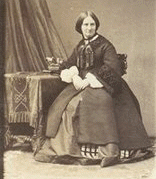
Lady Deborah Bowring née Castle (1816-1902) in 1864
It’s always difficult
when friends disagree. At the same conference the following year, Mary did not
attend; but Deborah spoke on topics ranging from the suffrage and married
women’s property to education – all of them subjects dear to Mary and her
inspiration, the Hindu social reformer Ram Mohan Roy. Roy was visiting Deborah’s
cousin Catherine Castle (1812-1834) when Mary met him in 1833, and it
is highly likely that Deborah met him too and was influenced by his convictions.
It could be argued that Deborah embodied both the philanthropic and political aims of the Women's Movement. Throughout her married life with Sir John in Exeter, and after his death, she was an active supporter of the local hospital and museum, and of education for girls in the city. And in 1871 Deborah became a vice-president of the Bristol and West of England Society for Women's Suffrage, an office which she held until her death. She has been described as an apt and dignified speaker who blended a good deal of humour with her shrewd and graceful remarks. Deborah made her last speech in support of the cause in May 1897.
It could be argued that Deborah embodied both the philanthropic and political aims of the Women's Movement. Throughout her married life with Sir John in Exeter, and after his death, she was an active supporter of the local hospital and museum, and of education for girls in the city. And in 1871 Deborah became a vice-president of the Bristol and West of England Society for Women's Suffrage, an office which she held until her death. She has been described as an apt and dignified speaker who blended a good deal of humour with her shrewd and graceful remarks. Deborah made her last speech in support of the cause in May 1897.
At that 1870
Social Science Association conference Deborah touched on the divisions between politics and philanthropy
in the Women’s Movement which the previous year’s conference had highlighted:
I
do not doubt that there are those present who do not consider that purely
benevolent action in the political area can be confined within such, or indeed,
any limits, but would deem it needful to consider that it is ultimately
associated with the attainment of the social advancement and proper position of
women, and more especially that she should enjoy that absolute political
equality with those of the other sex. Looking calmly and dispassionately at
these so-called women’s rights questions, I cannot but imagine that a time will
come when the justice of these claims will be recognised.
As Goldman
points out, Deborah’s convoluted language suggests the delicacy with which
she had to approach the subject. But although she added that the attainment of that
equality “must necessarily be distant,” she is quite clear that absolute
political equality is the goal. A hundred and forty three years later, I wonder
how she thinks we’re doing.

Lawrence Goldman’s Science,
Reform and Politics in Victorian Britain
(Cambridge University Press, 2002), from which much of my information about
Deborah Bowring’s work comes


 Posts
Posts


