All writing © 2009-2015 by Colin Salter unless indicated otherwise. All rights reserved.
More information at www.colinsalter.co.uk
Showing posts with label Macpherson. Show all posts

Saturday, 16 November 2013

ALLAN MACPHERSON (1788-1864), THE REVEREND SPECULATOR (Part 2)

Allan Macpherson, youngest son of the quartermaster general of Bengal, struggled to make his way in the world when the family’s fortunes collapsed. You can read about his erratic early life in my previous post, here. In Calcutta, at the age of 45, he married Caroline Gibson, with whom the following year he had a daughter Matilda Harriet. When an opportunity to raise the family in England arose, Allan grabbed it; and in 1835 he took up the post of vicar at Holy Trinity, Rothwell.

The early years at Rothwell were without doubt the most stable of Allan Macpherson’s life. At the age of 47 he at last had a family life and a secure income in a comfortable climate. Rothwell was a growing community, thanks in part to the presence of the brewery owned by the Gotch family of Kettering. John Cooper Gotch, head of the dynasty, had also founded a bank which grew out of his financial support for Christian missionaries. The two men must certainly have known each other, and it may have been their friendship which allowed Macpherson to run up debts at Gotch’s Bank of around £3000, a huge sum at the time of the banker’s death in 1852.

Five pound note of the Kettering Bank of John Cooper Gotch & Sons, c1855

Was it just comfort buying? Sorrow came back into Allan’s life with the death of his nine-year old daughter in 1843 and of his second wife in the 1850s. His faith must have been sorely tested. In 1852, mindful perhaps of his mounting deficit at Gotch’s, he looked to Europe where he saw money being made through the patenting of inventions and the exploitation of mineral wealth. With the permission, one assumes, of his bishop, Macpherson moved to comfortable apartments in Brussels “to retrieve myself,” and began to speculate with the hope of accumulating. His duties at Holy Trinity were covered by his curate Rev Charles Iliffe Gibbon; and tellingly, he asked the bank to stop addressing him as Reverend in case it cramped his style in this secular activity.

Over the next five years he registered a number of patents – for a fee – in the hope of selling them on for a profit, in the fields of gas supply, motive power and sewage management. He invested in slate, tin and iron ore mines too, and kept the bank informed at every turn (in nearly 500 letters) with assurances of imminent and magnificent returns. Those returns never arrived. When the Kettering Bank finally failed in June 1857, having thrown much good money after bad, Macpherson (now 69) owed it £25,000 – a third of all its bad debts.

Beyond the reach of the law and deprived of the bank’s funds, he turned to family members for support. But if they frowned at his financial dealings, they were appalled by the news that he had fathered a secret child during his time in Rothwell. He married the mother in 1860 and they lived for a while in England, keeping a low profile. But his relatives would have nothing to do with her, and his sister – who had already funded him to the tune of £1000 – turned off the tap. At their last meeting in 1862, Allan could not even afford new clothes. She gave him £5 and six shirts, and he left for Europe where he might live for less. He died in Paris in 1864.

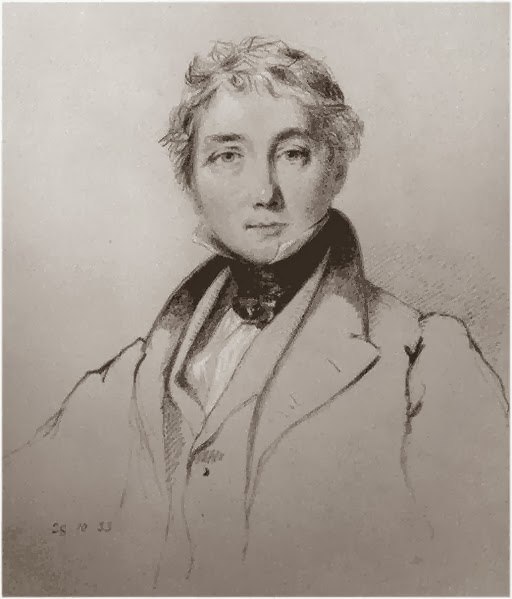
Allan Macpherson (1788-1864), photographed a year before his death (from Stephen Foster’s A Private Empire)

I don’t think Rev Allan Macpherson was a bad man. As a slave owner, minister and speculator he was only following the example of the times and his ancestors. But he was unlucky, weak and ill-equipped to deal with life. His nephew remarked, “There is a great deal of genuine kindness about him – but his utter lack of the smallest fragment of the commonest of common sense makes him in my opinion entirely removed from the list of responsible human beings.”

I found some details of Allan’s life in Stephen Foster’s tremendous book A Private Empire, a history of five remarkable generations of the Macpherson family of which Allan was very much the product and the black sheep.

Saturday, 9 November 2013

ALLAN MACPHERSON (1788-1864), THE REVEREND SPECULATOR (Part 1)


I am not related to the Reverend Allan Macpherson, only to the Gotch family whose private bank he almost single-handedly brought to collapse. But the vicar got under my skin when I wrote about him here a few months ago. As I looked into his background I uncovered an extraordinary life, which I had the great pleasure of writing up for the parish magazine of Holy Trinity, his former church in Rothwell, Northhamptonshire. Here is that article.

Reverend Allan Macpherson (1788-1864), who served as vicar of Holy Trinity Church, Rothwell from 1835 to 1855, lived a life so colourful that I can’t believe his Northhants parishioners knew the half of it. He hit the headlines in 1858 as The Reverend Speculator, the man who almost single-handedly caused the collapse of the Kettering Bank, and died in Paris penniless and abandoned by his family at the age of 76. The rest of his life was no less dramatic.

Macpherson means “son of the parson” in Scottish Gaelic. A different branch of Macphersons, on the Isle of Skye, had been Scottish ministers for three generations. Allan's branch were the Cluny Macphersons from mainland Scotland. Like many Scots after their hope of an independent nation was crushed at the Battle of Culloden, Allan’s father left Scotland to seek his fortune in the British Empire. He rose to become the Quartermaster General in Bengal.

Allan’s father Lieutenant Colonel Allan Macpherson (1740-1816), quartermaster general in Bengal, painted by John Thomas Seton (from Stephen Foster’s history of the Macphersons, A Private Empire)

For the Quartermaster handling supplies for the East India Company there were plenty of opportunities for augmenting one’s salary. When Allan’s father returned to Britain the year before Allan’s birth it was with the intention of investing his considerable fortune in Scottish estates. But he was unlucky in choosing a business partner who died suddenly with huge debts for which he became responsible. By the time Allan was born, the youngest of three children, the family was ruined.

With no prospects at home, Allan’s father sent him in 1805, aged 16, to learn business on the Guyana plantation of a family friend. He carried a letter of paternal advice which recommended him to “honour God, respect the negro, and avoid loose women,” ideally by taking a slave as a concubine. Allan already had a reputation within the family for being hot-tempered and flighty, and in Guyana he tried his hand at many things without much success – he joined the West Indian Army, he traded horses, he bred beef. By persevering in Guyana he missed the weddings of both his siblings and the death of his father. And from 1816 he fathered two children with Kitty, a slave twelve years his junior, whose freedom he bought before he returned – without them – to Britain in 1820.

James Baillie Fraser (1783-1856), who oversaw the Fraser plantations in Guyana to which Allan was apprenticed

Now, like many younger sons, he studied for the cloth. In 1823 received his first preferment, no doubt through family connections in Scotland, as the domestic chaplain to the Marquis of Tweeddale. He acquired a second living, Berwick St Leonard in Wiltshire, which was in the gift of his sister’s husband. And in 1826 he married Margaret Chalmers, the sister of his brother’s wife, with whom early in 1828 he moved to take up a post as chaplain at Dum Dum in Bengal, presumably as a result of his late father’s role in India. Although there is no record of children, there is a reference to “Allan Macpherson and family.” The Macphersons returned to Britain on leave that summer, but on the long voyage back to Calcutta in November, Margaret died.

Allan overcame his grief through work. He became chaplain at Calcutta’s newly built St James Church (consecrated in November 1829) and in 1833 married Caroline Gibson, with whom the following year he had a daughter Matilda Harriet. When an opportunity to raise the family in England arose, Allan grabbed it; and in 1835 he took up the post of vicar at Holy Trinity, Rothwell.

The early years at Rothwell were without doubt the most stable of Allan Macpherson’s life. At the age of 47 he at last had a family life and a secure income in a comfortable climate. But further personal loss and reckless financial dealings soon came to blight the unlucky Macpherson’s life once more. Read about his final descent IN PART TWO HERE.  I found some details of Allan’s life in Stephen Foster’s tremendous book A Private Empire, a history of five remarkable generations of the Macpherson family of which Allan was very much the product and the black sheep.

Saturday, 8 June 2013

AUSTIN COOPER (1825-1874) AND THE ROSCOMMON RAILWAY


Here’s another of my many ancestors called Austin Cooper. There are at least twenty-five even in my incomplete Tipperary Cooper notes, all ultimately named after the almost mythical Austin, the settler who brought the Cooper family to Ireland. I’ve written about some of them here – sea captains, tax collectors, artists, surgeons, murder victims. This one led an altogether less dramatic life, as the railway manager at Roscommon.

Roscommon Railway Station

It was then a very modern thing to be, of course. Austin was the eldest of three brothers, all of whom chose careers which simply weren’t available to their grandfather, Austin’s namesake the Irish antiquarian, or to the long line of landed Coopers before him. William was a chemical engineer in London, and John the youngest a telegraph engineer to an Ottoman Sultan. They had rather been forced into the modern world by the circumstances of their father.

Samuel Cooper had financial troubles: some of his Irish tenants (on the family estate at Kinsaley  north of Dublin) were withholding rent, and on top of that he was partly responsible for the debts of his late father. These troubles necessitated his living between 1832 and 1857 beyond the reach of the British legal system – on the Isle of Man at some stage, but chiefly in Brussels. (Brussels seems to have been popular with those on the run – the Rev Allan Macpherson, for example, brought down the Gotch Bank in Kettering from there at exactly the same time that Sam Cooper was an ex-pat resident.)

Matters were cleared up in the courts in 1851 although Sam didn’t return from Brussels until 1857 when his third wife died there. The railway came to Roscommon on 13th February 1860 as part of the Athlone-Westport branchline. I don’t know when Austin got the job as manager there, or even precisely what the position involved – was “railway manager” the same thing as “station master”?

Roscommon Railway Station – the stationmaster’s house is the two-storey building on the left

Was he required to live on-site, or did he live at Kinsaley? Roscommon was then a small village and even now as the county town of County Roscommon it has less than 2000 inhabitants. The station’s main business was not in passenger traffic but as a railhead for the transport of cattle and other agricultural produce. If Austin lived in the stationmaster’s house at Roscommon, there won’t have been much to do there except raise a family. But of his large brood born between 1849 and 1871, only one was definitely born in Roscommon, in 1868.

Austin died relatively young in 1874. He was only 49, and his life at a quiet country railway station can now be measured only in wives (2) and children (15). At least two of his offspring emigrated to New York, and I feel there must be more to tell. Quiet little Roscommon Railway Station only hit the news in 1881, many years after Austin’s death.

Roscommon Railway Station, 130 years after it last hit the news

In 1880 the Land League lead by Charles Stewart Parnell had found considerable success in parliamentary elections. It was waging a land war – boycotting profiteering landlords, withholding rent, and intimidating new tenants of land from which the previous tenants had been evicted for such actions. In October 1881 the British government decided to act, arresting many of the Land League MPs including James O’Kelly, Roscommon’s representative.

Late one night, the graphic illustrator and engraver Aloysius O’Kelly (not I think a  relation of the MP) was asleep in his carriage as it arrived in Roscommon Station. “I was suddenly awakened by the screaming and yelling of the crowd on the platform [and] the frequent cry of “Hurray for Parnell!” I was astonished to find the platform lined with soldiers, two deep, behind whom was the screaming mob. They were shouting, gesticulating and waving hats to several men who had been arrested and who were being put in the train to be sent to Galway Prison.

“It appeared that these men were the leading Land Leaguers of the town of Roscommon, who had been arrested during the day. There had been reason to suppose that unless the assistance of the military had been obtained there would be an attempt to rescue the prisoners on their way to the railway station. The soldiers therefore marched into the town that night just in time to conduct the prisoners to the station. No one was aware that the soldiers were coming, so the people were taken by surprise, and their little plan for a rescue was a failure.”

“The State of Ireland: Arrested under the Coercion Act – A Sketch at Roscommon Railway Station” by Aloysius O’Kelly

There must have been hundreds of such scenes around Ireland that month, and this one would have been much less well remembered had Aloysius’s impression of it not been published in the Illustrated London News on 3rd December 1881. What would Austin have thought?


Saturday, 13 April 2013

THOMAS HENRY GOTCH (1805-1891) AND THE REVEREND SPECULATOR


How times have changed. It used to be that the three pillars of the community in which you could trust absolutely were the school-teacher, the vicar, and the bank manager. From 1858 here’s the tale of a banker and a minister that would undermine your faith in both, had events in the early twenty-first century not already done so.


I’m related by the marriage of a Davis (my 3x great grandmother’s family) to the Gotch family of Kettering; but family or not, I have to admit the Gotch banking skills left much to be desired. Gotch’s Bank, the family firm, didn’t even notice that it had been broken into in 1812 until the burglar’s accomplice turned on him and blurted it out in court. That was under the presidency of John Cooper Gotch. When John died in 1852, his sons Thomas Henry and John Davis Gotch took over a bank which was technically insolvent, with debts of over £28,000.

One of the main debtors was the Reverend Allan Macpherson, the vicar of Holy Trinity Church in Rothwell, a village four miles outside Kettering in which the Gotch family’s assets included a brewery. Maybe the reverend had some sort of understanding with Gotch the father which he didn’t have with Gotch the son; when Gotch senior died, Macpherson – who owed the bank £2,900 – effectively did a runner, abandoning his parish and moving to Brussels “to retrieve himself,” as he put it. There he set himself up in comfortable apartments, from which in 1853 he got back in touch with the bank, writing: “I shall be obliged by your addressing me as Monsieur Macpherson as I have not brought my clerical designation with me to the continent.”

The reason he gave was that, surprisingly, he had not described himself as a clergyman on his passport; and that he was engaged in secular business in which being a man of the cloth might confuse matters. He now began to borrow relatively small amounts from the bank in support of those secular business activities, holding out always the imminent success of them as the point at which he would be able to repay the bank for all its trust in him.

Holy Trinity, Rothwell, Northhants, where Monsieur Allan Macpherson preached before exchanging the cloth for the con

His letters to the bank, some 450 of them over the next four years, are short on hard facts and long on vague self-aggrandisement and any-day-now. His get-rich schemes revolved around a series of patents (including improvements to gas lighting and the recycling of human sewage) which he purchased at the bank’s expense in several European countries. He was also involved in various slate, iron and lead ore mining projects and a scheme to dig a canal from Hanover to Holland.

How much of this is true (I have found one record of one patent registration by him, in 1856, “for improving and applying motive-power”) and how much a Macpherson fantasy I cannot tell, and neither could the bank. All they had to go on were his own reports – he had “conditionally sold for £1,000 his French patent for double fish-tail gas burners;” he had “actually asked £20,000 for only one of his mines;” he had “orders for 123,000 slates;” “gentlemen of experience who had visited his various works said, that in a few years he must be a man of large fortune;” he had “very large contracts for the delivery of stone to the Government and the Luxembourg Railway, at large profits.”

A Gotch’s Bank note of 1856 signed by Thomas Henry Gotch – in 1857, not worth the paper it was printed on

None of these, it seems, ever came to anything. Yet on his word alone the bank continued to honour cheques for anything from £20 to £200 right up to the point, on 9th June 1857, when they filed for bankruptcy with a deficit of £82,000. Of that enormous sum, Macpherson’s debt amounted to £25,000.

Bankers always bounce back, don’t they? Thomas and Henry Gotch rebuilt the family fortunes – not in banking but in shoe manufacture. By the time of the bank’s collapse, Macpherson was almost seventy years old. With the bank's funds no longer available to him he turned to his family. They might have forgiven his financial incompetence, but when they learnt that he had fathered an illegitimate child back in Rothwell they cut him off. He died in Paris in poverty in 1864 at the age of 76. A full account of his spree comes in an edition of the Monetary Times of 1858.

The Market House, Rothwell, Northhants, now the town council chamber - begun c1578 by Sir William Tresham and completed 1895 by John Alfred Gotch (1852-1942) eldest son of Thomas Henry Gotch

It is possible, I suppose, that the death of his daughter Matilda in 1843 at the age of nine, or of his wife Caroline a few years later, may have set him off on his criminal path. The church of Holy Trinity may also have played its part – a once great thirteenth century building, it was far too big for its parish and had fallen into such disrepair over time (aided by an eighteenth century earthquake and a seventeenth century bolt of lightning which toppled the steeple) that by 1819 it was considered fit only to house the Rothwell fire engine! Perhaps his early borrowings were on its behalf.
Related Posts Plugin for WordPress, Blogger...