All writing © 2009-2015 by Colin Salter unless indicated otherwise. All rights reserved.
More information at www.colinsalter.co.uk
Showing posts with label Bowring. Show all posts

Saturday, 22 June 2013

DEBORAH CASTLE (1816-1902) AND WOMEN’S SUFFRAGE (PART TWO)


As I wrote in my last post here, Mary Carpenter and Deborah Castle grew up together in Bristol and shared a zeal for social and educational reform, influenced in large part by the teaching of Mary’s father the Unitarian minister Dr Lant Carpenter.

In 1869 the Misses Carpenter and Castle shared a stage in Bristol at the first Ladies Conference of the Social Science Association. Their contributions illustrated tensions within the Women’s Movement – should women simply take a greater public part in traditional feminine philanthropic “caring” roles? or should they campaign for greater rights?

Mary Carpenter (1807-1877) in c1870

Author Lawrence Goldman in Science, Reform and Politics in Victorian Britain describes events at the conference:
On 29th September Mary Carpenter, in the chair, told the congress was told that “they would keep clear of public or political subjects, and of what were called ‘women’s rights’, or their fancied wrongs,” adding later in the proceedings, “ladies should work modestly and quietly, and not seek after more publicity than is necessary to attain their object. She hoped that they would avoid political or religious discussions, women’s suffrage, or ‘rights’ … they were much safer in keeping to women’s work.”

The Ladies Conference met again on the following day, this time under the presidency of Lady Bowring, and it debated its raison d’être: “the question was whether that basis should be extended to the consideration of all subjects whatever in which women are interested, such as are treated of by the Congress in general, or whether it should be confined to the consideration of benevolent efforts and works by women, discarding political subjects such as Women’s Suffrage, the Married Women’s Property Bill, etc.”

Apparently “many ladies took a part in the discussion” and the majority favoured “the first proposition”, or what might be termed the political option. Miss Carpenter’s views had been overturned.
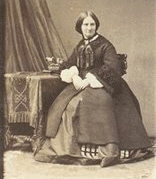
Lady Deborah Bowring née Castle (1816-1902) in 1864

It’s always difficult when friends disagree. At the same conference the following year, Mary did not attend; but Deborah spoke on topics ranging from the suffrage and married women’s property to education – all of them subjects dear to Mary and her inspiration, the Hindu social reformer Ram Mohan Roy. Roy was visiting Deborah’s cousin Catherine Castle (1812-1834) when Mary met him in 1833, and it is highly likely that Deborah met him too and was influenced by his convictions.

It could be argued that Deborah embodied both the philanthropic and political aims of the Women's Movement. Throughout her married life with Sir John in Exeter, and after his death, she was an active supporter of the local hospital and museum, and of education for girls in the city. And in 1871 Deborah became a vice-president of the Bristol and West of England Society for Women's Suffrage, an office which she held until her death. She has been described as an apt and dignified speaker who blended a good deal of humour with her shrewd and graceful remarks. Deborah made her last speech in support of the cause in May 1897.

At that 1870 Social Science Association conference Deborah touched on the divisions between politics and philanthropy in the Women’s Movement which the previous year’s conference had highlighted:
I do not doubt that there are those present who do not consider that purely benevolent action in the political area can be confined within such, or indeed, any limits, but would deem it needful to consider that it is ultimately associated with the attainment of the social advancement and proper position of women, and more especially that she should enjoy that absolute political equality with those of the other sex. Looking calmly and dispassionately at these so-called women’s rights questions, I cannot but imagine that a time will come when the justice of these claims will be recognised.

As Goldman points out, Deborah’s convoluted language suggests the delicacy with which she had to approach the subject. But although she added that the attainment of that equality “must necessarily be distant,” she is quite clear that absolute political equality is the goal. A hundred and forty three years later, I wonder how she thinks we’re doing.

Lawrence Goldman’s Science, Reform and Politics in Victorian Britain (Cambridge University Press, 2002), from which much of my information about Deborah Bowring’s work comes

Saturday, 15 June 2013

DEBORAH CASTLE (1816-1902) AND WOMEN’S SUFFRAGE (PART ONE)


Much is still imperfect in the social relationship between the sexes. But the recent anniversary of the death of Women’s Suffrage campaigner Emily Davison should remind us how far we have come in the last hundred years. And the fight for electoral equality had already been underway for perhaps a hundred years when Ms Davison died from injuries sustained while trying to tie a protest scarf to the king’s horse during the Derby.

I recently came across a Bergen University worksheet of quotations from campaigners for women’s suffrage in 1878. With great pride I found that two of the thirteen voices cited were ancestors of mine of whom I have written here in the past.

Mary Gurney (1836-1917)

One was Mary Gurney, daughter of my great great great aunt Emma Gurney (nee Rawlings) and author of Are We To Have Education For Our Middle Class Girls? Mary wrote in October 1878:
If women householders were not, as at present, excluded from the parliamentary franchise, their influence would be of much value in securing attention in the House of Commons to measures affecting the educational interests of girls.

The other was my favourite forebear, my formidable great great great aunt Deborah Castle. In October 1878, according to the Bergen University document, she declared:
My view with respect to the extension of the franchise remains unchanged. I cannot but think that those women ratepayers who like myself take an interest in social questions, must, as I do, feel strongly the injustice that is done them in being called upon to share in the taxation, without participating in the advantages conferred by property on the other sex, of a voice in parliamentary representation.

Sir John and Lady Deborah Bowring, in 1864, by Disdéri Eugène (who made his name and fortune after photographing Napoleon III in 1859)

Deborah blossomed in middle age. Thwarted in unsuitable love as a young woman, she seemed condemned to stay at home dutifully caring for her aging parents. The death of her widowed mother in 1856 finally released her, and four years later she married the radical but elderly Sir John Bowring (1792-1872). As Lady Bowring, Deborah emerged from the shadows of spinsterdom to become a radical voice in her own right, speaking from platforms on women’s issues and the Unitarian Church, of which both she and John were followers. She grew a reputation as "a woman of vigorous grasp of mind and efficient action."

Deborah, eleventh of thirteen children, was christened in Lewins Mead Unitarian Chapel in Bristol in 1816, in a sort of job lot with her three older siblings Charles, Caroline and Ellen. (Her other siblings were also christened there in similar batches.) A year after her christening, the pastorship of Lewins Mead passed to Dr Lant Carpenter, a campaigning educationalist who had taught Deborah’s husband at his previous appointment in Exeter and whose sermons must surely have influenced her thinking as she grew up in Bristol.

 Dr Lant Carpenter (1780-1840), c1830, from the memoirs published in 1842 by his son Russell Lant Carpenter; and Mary Carpenter (1807-1877), c1870, by Cyrus Voss Bark

Dr Carpenter’s eldest daughter Mary, although nine years Deborah’s senior, must have been a friend. Mary is remembered today as a campaigner for women’s rights and a social reformer who founded the ragged school movement. Besides her father, a formative influence on Mary was a meeting with Hindu reformer Ram Mohan Roy, who had fought since the early nineteenth century for property inheritance for Indian wives, education for Indian girls and an end to the practice of Indian widows immolating themselves on their late husbands’ funeral pyres.

(Mary met Roy while he was staying in Bristol with “Miss Castle and Miss Kiddell.” Roy died of meningitis at Catherine Castle’s home in 1833, and Catherine died in 1834, her will the subject of much speculation by Deborah’s brother Charles in a letter about which I have written here before. Catherine’s mother was Catherine Kiddell, and by the will a Miss Kiddell, presumably a niece of the mother and cousin of Catherine Castle, inherited an eyebrow-raising £7000. Mary’s father Dr Carpenter was left £3500, while Deborah, Charles and their eight surviving siblings had to share a mere £11,000 between them!)

Raja Ram Mohan Roy (1772-1833)

I digress. Mary Carpenter and Deborah Castle shared with Mary Gurney a zeal for social and educational reform and in 1869 the Misses Carpenter and Castle also shared a stage in Bristol at the first Ladies Conference of the Social Science Association. Their contributions illustrated tensions within the Women’s Movement – should women simply take a greater public part in traditional feminine philanthropic “caring” roles? or should they campaign for greater rights? More on that clash of ideologies in my next post.

Saturday, 13 October 2012

SIR JOHN BOWRING (1792-1872) AND THE KING OF SIAM


“Polymath” is the word regularly applied to my 3x great uncle John. He turned his agile mind to everything from translation to devising Britain’s decimal currency. He was an active industrialist and politician; and in the latter capacity he was both a trouble-maker and a trouble-shooter for the British government.

There’s not much more trouble you can make than dragging your country into a war. That’s what Uncle John did in 1856 while governor of the British colony of Hong Kong – the Second Opium War, all his doing, raged on until 1860. It was sparked by his rather high-handed, imperious stand-off with his opposite number the Chinese Imperial Commissioner in Canton. That typically British imperial over-confidence may have been encouraged in him by his success as a negotiating trouble-shooter the year before.

Sir John Bowring 1792-1872
trouble-shooter and trouble-maker
sculpted in 1857 by François-Félix Roubaud

In 1855 Sir John was dispatched to Siam (modern-day Thailand) to negotiate a trade treaty with the country’s King Mongkut. It was a fairly one-sided negotiation, if the truth be told. Britain had recently demonstrated its military might in the region with victory in the First Opium War. Its response to a failed negotiation with Siam five years earlier was the threat of gunboat diplomacy – the same threat with which Sir John triggered the Second Opium War in 1856, and the same threat which now helped to conclude what's now known as the Bowring Treaty.

The treaty opened Bangkok up to international trade, and other diplomats more or less duplicated the Bowring agreement in negotiating for their own countries. In return, Siam’s independence was guaranteed by the most important world powers of the time. So in effect my great great great uncle’s work kick-started the modern economic development of Thailand and trade in general across Southeast Asia (the Second Opium War notwithstanding!).

L-R: Anna Leonowens (1831-1915) painted c1900 by Robert Harris);
King Mongkut of Siam (1804-1868) photographed c1865 by John Thompson)

One of the unexpected benefits of the new British freedoms within Siam was the employment of an English schoolteacher, Anna Leonowens, in the education of King Mongkut’s wives and children. She taught at the royal court in Bangkok from 1862 to 1868, and her experiences there were fictionalised by author Margaret Landon in her 1944 novel Anna and the King of Siam. The novel was filmed with Irene Dunn as Anna and Rex Harrison as the king in 1946, and the film’s success prompted the team of Rodgers and Hammerstein to write a stage musical with Gertrude Lawrence and Yul Brynner in the lead roles.

Anna played by Irene Dunne, Gertrude Lawrence and Deborah Kerr

Their musical The King and I opened in 1951 and a film version was released five years later with Brynner again as Mongkut and Deborah Kerr taking on Anna in place of the late Gertrude Lawrence. Two other screen interpretations of the story, both called Anna and the King, have been made: a 1972 TV series with Brynner playing opposite Samantha Eggar, and a 1999 non-musical film adaptation of the Landon novel, with Jodie Foster and Chow Yun-Fat. A cartoon version of the musical appeared in 1999 with Miranda Richardson voicing Anna and Martin Vidnovic the king. (Christiane Noll sang Anna's songs.)

Anna played by Samantha Eggar, Miranda Rchardson and Jodie Foster

Just think, if it hadn’t been for Sir John Bowring’s diplomatic skills and Britain’s naval rule of the south-east Asian waves, we might never have had a Second Opium War. But nor might we have had such show-stopping songs as Hello Young Lovers and Getting To Know You. History is full of what-ifs.

I'm delighted to add in August 2014 that a new biography of Sir John Bowring has just been published. "Free Trade's First Missionary" is written by Sir John's descendent Philip Bowring and deals with his time in Europe and Asia. Chris Patten, former governor of Hong Kong, said of the new book: "This scholarly and very readable biography, written by one of Asia's most distinguished journalists, shows how free trade became part of Hong Kong's DNA." It's published by Hong Kong University Press and is available on Amazon as a real book and also in a Kindle edition. (And this blog is acknowledged in the introduction!)

Saturday, 14 August 2010

SIR JOHN BOWRING (1792-1872) AND BRITAIN’S FIRST DECIMAL COIN

I wish I had some record of the reaction of Deborah Castle’s family, her brothers and sisters, to her marriage at the age of 44 to Sir John Bowring. I know that Sir John’s family, in his case his children, were not pleased that she was replacing their mother in his affections and in their family home.

From Deborah’s point of view she was at last free to marry following the death three years earlier of her mother, whose lifelong companion she had resigned herself to being. She was 24 years younger than Sir John, whose first wife had died two years earlier. He was certainly in need of a friendly face, having just returned from a disastrous last public appointment as governor of Hong Kong (see my post about his launching the Second Opium War!).

Sir John and Lady Bowring,
photographed by Disdéri Eugène, 1864

Starting a war was not the best way to round off an illustrious career. Sir John had made his mark in many arenas – as a politician, linguist, iron magnate, hymn-writer, you name it. One of his last acts as an MP, just before his posting to Hong Kong, was to lay the foundations for Britain’s decimal currency.

The chain of events began with the fire which burnt down the old Palace of Westminster in 1834. When it was thought that the nation’s standard weights and measures had been lost in the blaze (the standard yardstick and so on) a new Royal Commission for Weights and Measures was set up. Its report in 1842 – how slowly things move in British politics! – went beyond its terms of reference in arguing the advantages of a decimal system of currency as well as of weight, volume, distance and so on.

The destruction of the Palace of Westminster
(JM Turner, 1834)

A second commission was deemed necessary, to confirm the findings of the first, which it did after only a year in 1843. A mere four years after that Sir John Bowring, a leading supporter of decimalisation, argued a proposal for it in the House of Commons.

Younger readers may not know the full extent of the madness that was Britain’s old currency: there were twenty shillings in a pound, although until 1816 the largest coin was not the pound but the guinea, worth twenty-ONE shillings. Twelve pennies made up each shilling and there were four farthings in each penny, 960 farthings to the pound. This was in the days when a farthing could still buy something and a pound was an unimaginably large sum of money for most people.

Other coins over the years included the crown (worth five shillings), the half-crown (worth two shillings and sixpence), the shilling, the sixpence, the threepence (pronounced thruppence or threppence), the penny and the halfpenny (pronounced hayp-knee). From 1816 there was for a while a coin worth one pound, called a sovereign.

British small change circa 1970

As Sir John said in 1847, Great Britain stands alone with her complicated and entangled system, so unintelligible to foreigners, and often so embarrassing to her own subjects.” He suggested a pound divided into 100 new units called Victorias, with ten Victorias making an intermediate unit called a Queen. (He also suggested retaining and revaluing the smaller coins: the farthing would become 1/1000th of a pound instead of 1/960th, the ha’penny 1/500th and the penny 1/250th, to ease the transition for the public.)

Although it was a mathematical nightmare, the old currency was much easier to work with in common fractions: 240 pennies can be divided by two, three, four, five, six, eight, ten, twelve, fifteen, sixteen, twenty and twenty-four and still leave a whole number of pennies, unlike 100 cents, centimes, centesimi, Victorias or anything else.

The principle objection to decimalisation in Britain however was not the maths but the fact that Britain’s major enemies of the past 50 years, France and America, had gone decimal with the franc and the dollar. Doing what they had done would never do! Instead the government decided to take a little time to consider the idea, and as a holding measure agreed to Sir John’s suggestion of a new coin worth one tenth of a pound (two shillings) to be called not the Queen but the florin. (Bowring later said he had wanted it to be called the dime.)

The Godless Florin of 1849,
"one tenth of a pound"

The “little time” the government took to decide in favour of full decimalisation was in fact 124 years, for most of which we lived with the madness of two almost equally valuable coins, the florin worth two shillings and the half crown worth two and a half shillings. Bowring’s florin survived the 1971 changeover to become the “ten new pence piece,” which was shrunk to its present 10p size in the bicentenary of his birth, 1992.

It is lucky to have survived at all. The first florins, appearing at last in 1849, became known as the godless florins. The design omitted the usual Latin phrase Dei Gracia Fidei Defensor” “By the grace of God, Defender of the Faith.” Queen Victoria and the general public were outraged, especially when it became known that the Master of the Mint was a Catholic. The coin was blamed for everything from economic misery to plague and pestilence, and quickly (1851, quick by British standards, at least) redesigned.

 I'm delighted to add in August 2014 that a new biography of Sir John Bowring has just been published. "Free Trade's First Missionary" is written by Sir John's descendent Philip Bowring and deals with his time in Europe and Asia. Chris Patten, former governor of Hong Kong, said of the new book: "This scholarly and very readable biography, written by one of Asia's most distinguished journalists, shows how free trade became part of Hong Kong's DNA." It's published by Hong Kong University Press and is available on Amazon as a real book and also in a Kindle edition. (And this blog is acknowledged in the introduction!)

Saturday, 1 May 2010

CHARLES CASTLE (1813-1886) AND A TOWN CALLED KIRKLAKE


I inherited the contents of my 3x great uncle Charles’ writing desk a few years ago. They are an amazing survival – 150-year old bundles of correspondence, sometimes complete exchanges including not only letters received but the draft versions of his replies to them.

One such bundle, an exchange of eight letters between Castle and a Whig called Charles Thompson, deals with his hopes of becoming a Liberal candidate in the 1857 general election. Parliament had been dissolved when the coalition government of the day collapsed in disagreements about the Second Opium War (see my recent post on Sir John Bowring). The Prime Minister Lord Palmerston, a Liberal, had lost a censure debate on 3rd March over his support for Bowring (the governor of Hong Kong) and Parkes (Bowring’s Canton counterpart) and called a snap election for 30th April.

When the Tory motion of censure was carried, Palmerston portrayed it as a vote to “abandon a large community of British subjects at the extreme end of the globe to a set of barbarians - a set of kidnapping, murdering, poisoning barbarians.” (Bowring’s wife had been poisoned by a Chinese baker.) Only six years after the triumphant (and triumphalist) Great Exhibition, popular sentiment was with Palmerston and the Empire.

Charles Castle (1813-1866),
letter writer, Whig activist

Charles, a Bristol man, was a natural Liberal, a Unitarian by religion, and he must have fancied his chances when within a week of the censure his friend Mr Hunt proposed him as a candidate of Liberal principles in the Bridgwater constituency. The Borough returned two MPs and hopes were running high that they could both be Whigs (the predecessors of the Liberal Party) for the first time since the general election of 1835.

But first, there was a Committee to get past, and that Committee had set up a Sub-Committee to draw up a short list … For all his Liberal virtues, Charles was an impatient man. Accustomed to getting his own way, he was irritated by the Committee’s delay in selecting a candidate even by a day, writing “I trust they will be able to justify themselves to the Electors. If invited now, which I confess I do not expect, I should feel bound to approach a contest with some caution.”

Four days later, Castle heard that he was not selected. Worse, Mr Otway, the local man chosen over him, declined to stand after all. With time running out, the Bridgwater Liberals opted for a celebrity candidate, a popular travel writer and historian called Alexander William Kinglake who had unsuccessfully contested the seat in 1852. When in spite of being rejected Castle offered to lend his forceful support, Henderson assured him that there was no need – “if we have fair play we are sure to win, and if our opponents want to have [corrupt] practices, why they must take the consequences. … We are such a majority on the Register that we have no need to imperil our cause.”

Alexander William Kinglake (1809-1891)
historian, travel writer, MP

Bridgwater elected two Whig members in 1857 – Kinglake and Charles Kemeys-Tynte. Kinglake was returned at next two general elections, but the result of the 1868 general election in Bridgwater was voided on petition on 26 February 1869 because of Liberal malpractice. No by-election was held, and after a Royal Commission found that there had been extensive corruption by both Whigs and Tories, the town was disenfranchised in 1870 and incorporated into the West Somerset constituency. It was reinstated in 1885. But 140 years later, boundary changes see it once again subsumed in the single “Bridgwater and West Somerset” ward in time for the 2010 general election.

Perhaps Kinglake was distracted by his other career. His magnum opus was his “Invasion of the Crimea,” in 8 volumes, published from 1863 to 1887, described on Wikipedia as one of the most effective works of its class. It has been accused of being too favourable to Lord Raglan, and unduly hostile to Napoleon III, for whom the author had an extreme aversion. But it was popular enough for the timber town of Kinglake in Victoria, Australia (2006 population 1482), to be named after him a year after the publication of the final volume.

Kinglake, Victoria
Black Saturday, 7th February 2009

I’m not sure why – neither he nor the Crimea seems to have any other connection with the town, the state or the continent. The town in turn lent its name to a huge forest National Park established in 1928. Both town and park were devastated by bushfires on 7th February, Black Saturday, in 2009. 98% of the forest was destroyed and over 100 lives were lost in the town.

For Charles Castle, that last note from Charles Thompson, confirming that not only Mr Otway but also Mr Kinglake and a Mr Follett had been picked ahead of him, marked the end of his active involvement in politics as far as I know. Charles Thompson (1815-1889), a fellow Unitarian whose ancestors had been Quakers, moved to Cardiff later that year with his family and became chairman of Spillers Flour Mills. Cardiff’s Thompson Park was donated to the city by his son (also Charles).

Charles Thompson’s final note to Charles Castle
confirming the choice of Liberal electors for candidates,
28th March 1857
Related Posts Plugin for WordPress, Blogger...